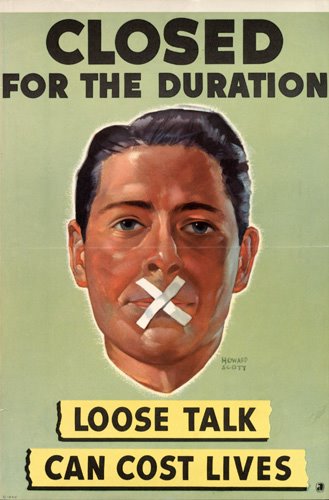
Friday, December 30, 2005

impulse buy of the week

Conceived In Liberty If you've ever desired the four-volume hardcover edition of Murray Rothbard's "Conceived In Liberty" set, but have not purchased it because you chose not to forgo the utility the $100 could secure in other goods, I've recently noticed that Amazon.com is carrying it for a total of $63, including the shipping (which is only nominally 'free' since distribution is just another element of production which readies it for a consumers usage.†)

If your as lucky I was, you'll discover it further discounted in your Amazon Gold Box which offered me another $4 off the price.


†See Murray Rothbard, Man Economy and State with Power and Market (Ludwig Von Mises Institute, third edition, Scholar's Edition, 2004), pp. 617-623.

Thursday, December 29, 2005

why oh why

I openly admit that I've really never had it in me to obey authority. On that basis I was tempted and often succumbed to defying authority for the sole pleasure of having the means coincide with the ends. I've always found the justification of obeying authority to be absurdly illogical -- "The reason why you must obey is because you will be punished, or forced to comply regardless".

Why implies causation. If I ask myself why I shouldn't punch a steel column, the why in this example means 'what are the consequences related to the actions I contemplate performing'. In this case, when I answer why, I will be able to direct my behavior in a rational manner. When somebody asks "Why is the sky blue?", the answer whether if correct or not, will try to explain what causes the sky to be blue.

However, when the school bully asks me for my lunch money, the consequences of refusal are a causation of not my own, but rather his actions. The why in this case does not imply causation; in this example, the bully may simply head off in search of easier marks when refused.

Still, when faced by a bully's biceps, a highway robber's gun, or a black-robed gavel holder, the rational action to take may be compliance. However, there is no why; violence destroys all attempts at civil discourse and interpersonal rationality (hello game theory!)

Crap! I'm starting to sound like Ayn Rand; well, except that she was supposedly a minarchist who dismissed anarchy as an unthinkable thought experiment, a blatant assuming of the conclusion. Being that she recognized (minimal) government, I wonder what she would have to say on the why of obeying authority altogether.

Tuesday, December 27, 2005

a layman's scientific inquiry

One hears a claim from time to time from the environ-mentally challenged individuals (of the watermelon genus), that the melting of icebergs will raise the level of the Earth's oceans. Put aside for the moment whether human beings are effectively responsible for this, and what can or should be done about this.

Just follow this simple science experiment. Put an ice cube or two in a glass. Add water to the glass until the water reaches the rim of the glass. The ice cubes will then jut above the rim of the glass. Set aside the glass for a few minutes until the ice cubes have melted down somewhat. You will notice that the glass has not overflowed its container. Go ahead and leave it and come back a half hour later when the cubes have all melted away.

Wait, that's crazy, where has the water gone? It has not evaporated away if that is what you are thinking (not enough to make a difference anyway.) The answer is simple.

Ice is less dense than water; it will take up more space than water of the same mass. IIRC, the ratio of densities of ice to water is 1/9 less. That is why ice floats on water, it cannot displace a greater mass for the same volume. It can displace a lesser mass of water though, if it lies partially out of the water. That is why a small portion of icebergs and ice cubes protrude out of their surrounding liquids.

Anyway, to get back to my initial inquiry; even if all the world's icebergs melted completely due to global warming, what do we have to worry about?

Wednesday, December 21, 2005

There is kosher and then there is Kosher

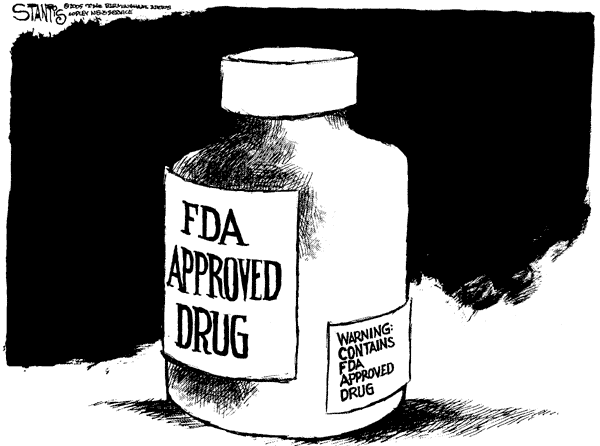
Behold, here lies yet another recount of a roundtable conversation where I've often find myself present. The participants of this verbal joust is my father-in-law, a pharmacist by trade, and I, a decrier of an innocent world spoiled. Manifest: One printed copy of Alex Tabarrok's "Assessing the FDA via the Anomaly of Off-Label Drug Prescribing".

Being that my dad-in-law tends to be a more cynical fellow, I try to win him with facts, not logic. Confronted with logical arguments, he alleges that without the FDA, pharmaceutical companies would lie, cheat and kill millions of unsuspecting customers with impure, unsafe products. So I showed him the study. Countless thousands have already died because of the FDA, and manifold more injured or prolonged in unnecessary, treatable pain due to their feet-dragging, the "not-invented-here" willful blindness, and agenda-driven policy.

But after all it's hopeless, because the duty to prevent the alleged death of millions outweighs the present harm of hundred-fold thousands.

What I learned from our conversational banter was that once the state trundles into a field, be it medicine, protection services, judicial system, security trading, etc; it automatically adjusts the plebeians attitudes regarding the trustworthiness of individuals who would offer the same services sans the governments oversight. To the plebian, there can no longer be "regulation" without "Regulation" for that industry.

My parting shot, which I do not think ultimately made it home, was to give an example of an industry that is familiar to the both of us, is strictly regulated, trusted by its consumers, but yet is not intrusively Regulated. Here the hope is that the light of reason might finally shine through; that spontaneous market regulation is preferable to the inferior variant dressed in bureaucrats raiment, and is the only "regulation" truly deserving of the name.

This subject to which I am referring to is the kosher industry. There is a very good reason why I picked this industry, and not say, the computer industry; in the Jewish orthodox consumers' mind, a government stamp certifying kosher is worthless; the mark of a kosher certifying agency such as the OU is worth its kosher weight in gefilte fish or challah, depending on what item you are holding at the time.

This example should befuddle the Jewish orthodox plebeian when pointed out- "Why do I implicitly trust the OU to certify kosher, when I wouldn't trust the same person to sell me medicine?"

Hopefully, this sets their mind in motion, questioning why are they prejudiced to either trust or distrust others based on the given industry. But there are pitfalls to this logical approach- witness this dimwit on Slashdot - "The reason most industries that are regulated are regulated is precisely because the market doesn't work for that industry!"

This demonstrates how the mere existence of the state into the regulation business is a recursive nightmare executed upon the unthinking plebeian. The twisted logic goes as follows: Because the state regulates it, the market participants are presumed dishonest, thus justifying the states intervention to regulate it. And to think that this Kafkaesque miasma is the everyday reality of the plebeian, how I pity them.

Sunday, December 18, 2005

sadomasochistic plebeians


practically begging the state for a whipping....

The Gotham Gazette recently covered the topic of Eminent Domain in regards to three prominent development proposals for New York City. The most heated fight is taking place in the Prospect Heights section of Brooklyn, where developer Bruce Ratner has the blessing of politicos to whip up a sports arena, mega retail stores, as well as thousands of new housing units.

The trouble begins when there are hundreds of people already living there, and running businesses in the targeted area. They don't want to leave, and many aren't looking for a handsome hush-money buyout (currently they must sign "gag orders" upon selling, and promise to do naught but promote the development plan).

Unfortunately for them, they have little choice in the matter, as an opponent of the Columbia University expansion proposal explained:
"They say 'deal with us now or deal with the state later,'" said Whitman, who also sits on Community Board Nine. "It's like having a gun to your head."


While I support the efforts of, and commiserate with the people for experiencing the business end of a gun, I cannot for the life of me understand why they still continue to confer legitimacy to the one agency which is holding the whip, or in this case, the gun.

Witness the roadblocks they attempt to place before the impending condemnation; they talk about the public wealth transfer to Ratner, they complain that the community has no Land-Use Review power as this proposal sidesteps the Community Board with blessing from the city and state, they complain that architecturally significant buildings will be lost to wrecking balls and bulldozers, that many of the 53 to-be-condemned buildings are historically significant because they functioned as underground railroads where escaped slaves found sanctuary.

In effect, they are doing everything but confront the source of the problem- the state. You see, in their minds, eminent domain is fine and dandy as long as the right people are in office-- the same naiveness we suffer hearing about every election cycle. Do they really think it makes a difference with whom lies the whip of state power?

Their pitiable defense amounts to one thing; a demonstration that the statist 'casus belli' for attacking property rights is nothing more than convenient excuse to cover up privilege. It is nothing less than laughable to then attempt using the states' lame rhetoric such as the "interest of preserving cultural landmarks", or "protecting the middle-class renters" to stop them from dispensing privilege, as that is what the rhetoric is meant to make honorable in the first place.

In short, I'm unhappy that these people are drawing the short straw; however when they agree in principle with the state having the ultimate right, and only disagree over the degree of final measure, I think they just have the whip coming to them.

Monday, December 12, 2005

life imitates art

From an anonymous mises blog comment:
...in a few months, the housing market will keep slowing down, and eventually, crash. Everyone will be screaming, "Oh my God! Oh my God! We thought the market was just going to slow down, but it's a crash! Save us, Bernanke! Save us!"

Bernanke will appear in the sky, his cape blowing in the wind, and he will proclaim, "Never fear, for the Fed is here!" He'll roll back his sleeves, fly over to his printing press, and switch the dial from "high" to "full power".


Now all we need is for an austrian-minded cartoonist to draw this up and we'll have art-imitating-life-imitating-artfully-wrong monetary conceptions.

Sunday, December 11, 2005

subsidizzied

Critics of the mortgage interest tax deduction point out that homeowners are in effect having the state subsidizing their choice to purchase a home above those who choose to rent one. While upfront this charge appears to be a valid criticism of unjust state intervention on behalf of owners, I believe it can be refuted to satisfaction both from an ethical standpoint, but more importantly from a economics viewpoint.

The ethical charge is that by allowing income tax deductions, the state is influencing my choice to own a home instead of merely renting its service, unevenly distributing the 'costs' of maintaining government via disproportionate taxation to those who can't afford or choose not to buy a home.
From the homeowners perspective, he certainly might have contemplated the tax advantages, it's dishonest to label this as equal to a coercive relationship where the burdens of one are shifted onto others for a very simple reason; John Q. Homeowner may have never formally consented to being responsible for a certain 'fair' share of a national tax burden. Thus so, his avoidance of tax penalties can't be labeled unethical, any more so than any person who attempts to avoid financial or bodily harm.

You cannot easily claim that the homeowner consented to his government's claim on his income based on the fact that one "chose" to live within its territory, as there can be no such thing as choice, nor consent where coercion is being imposed upon unwilling individuals.

Choice is the expression of an individuals free will. One has the free will to makes choices, even in choices which may result in painful conditions. For instance, a person whose appendage is gangrene may have to make the difficult choice of amputation, and being that the nature of the circumstances is not determined in the human realm of action, a person who has to choose between death by infection or amputation of a limb is still making a choice, however hard.

On the other hand, a person who is told to choose between "your money or your life" did not make a choice when he hands the robber his wallet, since the false dichotomy of choice is only the result of the robbers actions fostered against the victim. The robber whom is later caught cannot claim that the wallet's former owner gave his possession of it willingly, and of his own choice. This is what a statist wants you to believe-- that your choice to not pick up and move elsewhere is a expression of your true choice and an express willingness to participate in the political system to which one is subject.

[Of course there is also the practical concern that there is nowhere one can go to escape the claim of some sovereign over the individual, so the assertion that a coerced individual chose his fate of political participation based upon where he chooses to live is a specious one.]

To get back to the subject matter, we may also examine the ramifications of the "unfair" tax benefits to housing, because perhaps it does not even effect what people think it does. To repeat-- the claim that home ownership is being subsidized by government, one has to first show that home owners are actually saving money by choosing to own, instead of renting.

A while ago I read a post on Cattalarchy by Bill Cholenski which opened my eyes to this matter:
A quick point (or three): when you buy a house, you buy the location, you buy the bricks, you buy the new windows. You buy the garage, the driveway, the shade in the backyard on the hot summer afternoons. You buy the proximity to highway (or train), the local deli, movie theater, or shopping mall. You buy many things that contribute to the value of the house. They all contribute to the PRICE of the house.

What some people forget is that YOU'RE ALSO BUYING THE TAX ADVANTAGES. You're paying for the privilege of getting money back each year. IT DON'T COME CHEAP... My point: house prices are higher because of these tax advantages... Anything worth buying is worth paying for. You can't get something for nothing. There's no free lunch. Houses are not magic. [insert catch-phrase here].

Bottom line: Tax deductions on mortgage interest don't benefit the people they "intend" to help.

Even without looking to empirical studies, it can thus already be deduced that the cost/benefit ratio of home ownership is not as sexy as your accountant thinks it is. One might attribute the benefit of "building equity" as the primary reason that people prefer the pricier option of home mortgage payments instead of "throwing away your rent money", but the more I think about the popularity of car leasing, the more it tells me that people are not so much interested in owning the cow as they are in just paying for its milk.

Empiracally (however much weight you deem to the science of statistics) it has been shown that for New York City, the cost benefit of renting is around 30% lower versus owning. Unfortunately I don't have the studies handy, nor have I actually read them, but the 30% disparity has been long bandied about in the Rent Vs. Own argument, which like the pheonix, is revived from flamewar to flamewar on the real estate blogs I peruse. Even without going into the specifics of the criteria selected for the studies, I am comfortable saying that the studies are just telling us what we already know.

I am not per se for the mortgage tax deduction, I just think it deceptive to call it a subsidization deserving of a good paleoliberal's scorn. I do readily admit though, that because most people think like accountants and not economists, we probably have an overinvestment in home ownership, rather than something that would more closely reflect the popularity of auto leasing which is less tax distorted.

If the mortgage tax deduction would be eliminated, one could bet dollars to donuts (fun fact #36) that the rent/owning price disparity would shrink as people would --

a) no longer pay for the tax advantages of ownership
b) would no longer overinvest in homes, thereby both lowering demand for condominiums and at the same time increase demand for leased rentals

The hard part is explaining that an anarchocapitalist does not truly favor market distortions created through government intervention; to opine that it's wrong not to object to a mortgage tax deduction on the basis of subsidization is just really undeserving, and ignores the reality we coerced individuals are subject to.

Tuesday, December 06, 2005

'rights' can do you wrong

While driving my car this morning, I caught myself ignoring my own advice about avoiding complacency. Being that road conditions are suboptimal due to snow over the weekend, I should know better than to not give myself ample braking distance for collision avoidance when driving down a street with cars parked on either side. If any driver should suddenly pull out within a short distance of my car, even at 'normal' speed the results can be disastrous.

Yet that wasn't even contemplated in my head you see, because I was thinking that drivers cannot, yes, physically cannot pull their car out, since I have the 'right-of-way'. Of course, since I have 'right-of-way', drivers without it will always be 100% vigilant to triple-check before they assume possession over the road, and thus I will be able to sail down the street confidently, without the fear of getting swiped by a vehicle pulling out.

That is one of the problems with created 'rights'- they perpetrate a mentality that as long as the adherent is within 'rights', they are untouchable, when of course in reality, a driver struck by a car wrongly rushing into an intersection against the light, cannot then appeal to a metaphysical court of 'rights' to deny the car collision on the physical plane.

I don't want to label this 'rights' mentality as naive, after all don't we all make assumptions and have expectations regarding the behavior of others? (No, I don't make pretense to understanding game theory) And what I'm not saying is that car accidents should never happen; after all we're human, and are highly capable of making error in judgment.

What I'm trying to convey is that we would have less accidents and incidents if people stop treating socially-imagined rights as though they are laws of nature, such as gravity.

And if I may just sum this all up- I'd rather be safe, than right!

Friday, December 02, 2005

who needs crime when you have friends like the state?

I came across a short, but insightful passage from a LewRockwell.com articles titled Does Government Protect Us? by Anthony Gregory:
The state now seizes about half the wealth in the country. Does it not seem odd that the organization claiming to protect our lives and livelihoods needs to expropriate an entire half of our resources to do so? And what is it protecting us from, again? Could private criminals on their own really steal the trillions of dollars in wealth consumed annually by the bureaucracy, kidnap as many innocents as the police state, and kill as many as the federal war machine? To ask the question is to answer it.
If I'd relate this to a statist, the most like response I'd get would be "Yeah, but if there was no government, criminals and warlords would take all your wealth" or "If you don't like it here, why don't you go to [insert some other abusive government here]".

What I really can't understand is why people have a tendency to believe the worst in others, as though if not for our benevolent government master, we would be tearing out each others eyes and throats, and so the expropriation of only half our wealth in return is too good a bargain to pay for this arrangement.

I do however have a strong feeling that this ingrained distrust and fear of others is due to our present state conditioning, which trains us to form into primitive bands of savages who employ acts of political plunder to survive, and the perverse notion that this method is even the most noble of acts!

Is it really any surprise that when people are politically pitted against each other, they will quickly look into irrational differences, such as gender, racism, religion in order to 'rationalize' their intolerable positions? Even while these irrational notions may arise on their own in the non-political sphere, they tend to be corrected, as the grocery store owner that refuses a black customers patronage will soon learn the better that it benefits no one to foster such irrational beliefs of superiority premised upon the genealogical heritage of another person.

In short, the state profits when we bicker, as this is a self-fulfilling dystopia which only lends further credence to the organization which tells us constantly that we can't be trusted to live together peacefully, and thus we are subject to their good-hearted protection.

Monday, November 28, 2005

price gouging 101

While reading the Mises blog, I came across an excellent, although unsigned blog post, which tersely and yet effectively defuses the cries of "there ought to be a law"-types who think that coercion is the answer to everything, without realizing that coercion is usually the source of the problems to begin with. The one caveat I would attach is that the first argument is an ethical argument based on the premise of private property rights, and not based upon Austrian economics, but rather a libertarian philosophical grounding.

From an Austrian perspective, the notion of price gouging does not exist – the gasoline is the gas station owner’s property and he/she is under no obligation to sell it for any particular price, nor am I, as a consumer, obligated to buy... Even among those who agree in principle with market based pricing, the price gouging mentality has gained a foothold – even conservative radio talk show hosts have caught the disease.

The concept most people, seem to have most difficulty with is the replacement cost argument – the refinery or gas station bases it prices on what it expects to pay for its next delivery and not to recoup the cost of the last one. People understand that nobody will sell them 1000 shares of Google for 10% above last January’s price, or a Pacific Heights apartment for 20% above its 2000 price, and consider that this is perfectly reasonable.

Yet the same people expect a gas station owner, who paid $2.50 a gallon for the gas now selling at the pumps, to be morally bound (and in some states legally bound) to sell it for a “fair price”, $2.58 a gallon, even though the cost of the next shipment from the refinery will be $2.75 a gallon.

Sunday, November 27, 2005

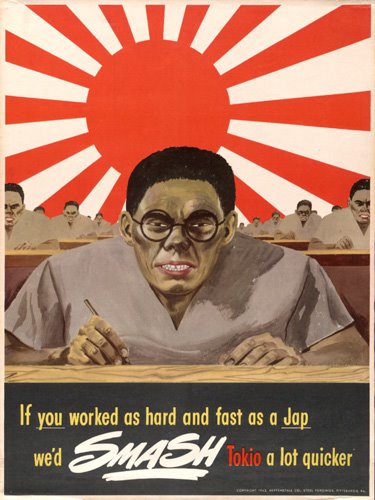
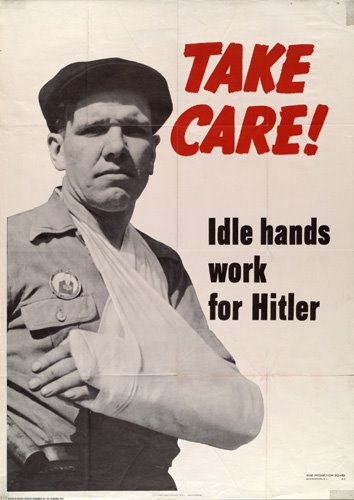
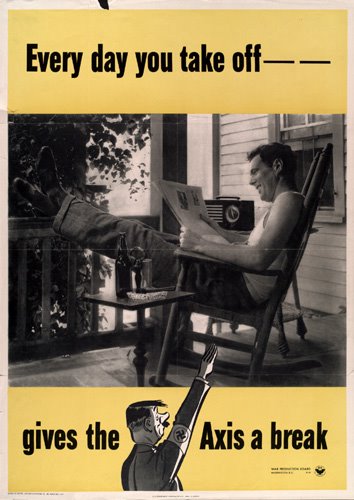
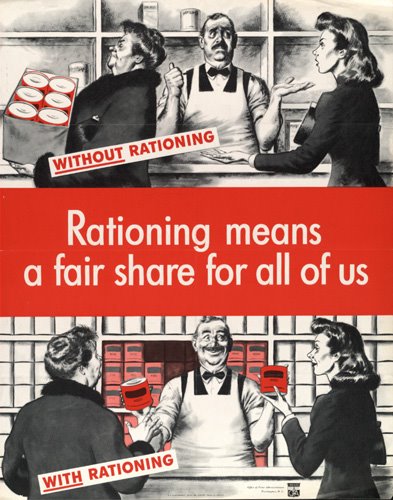
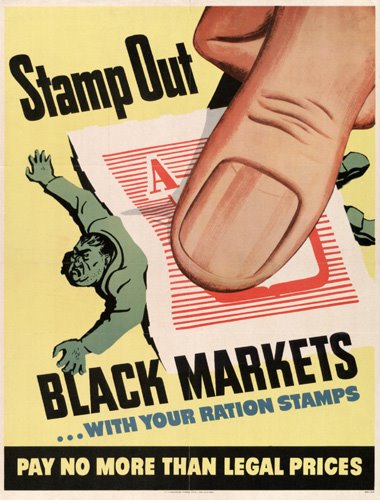
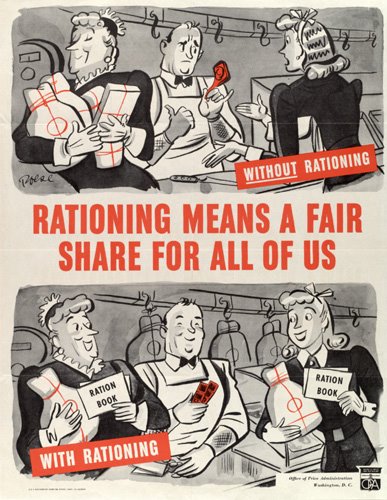
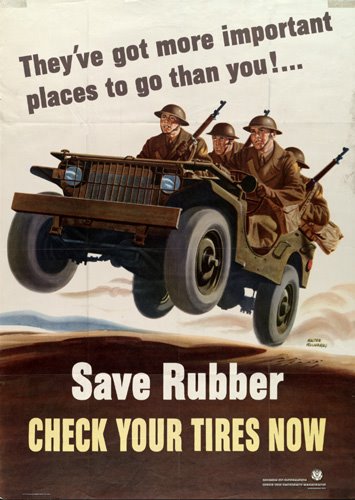
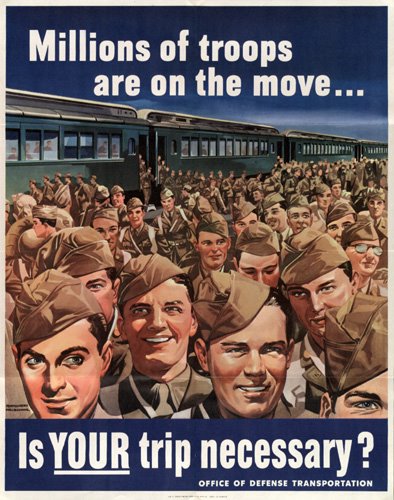
propaganda redux

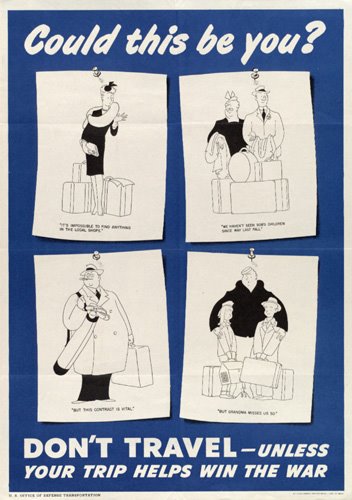
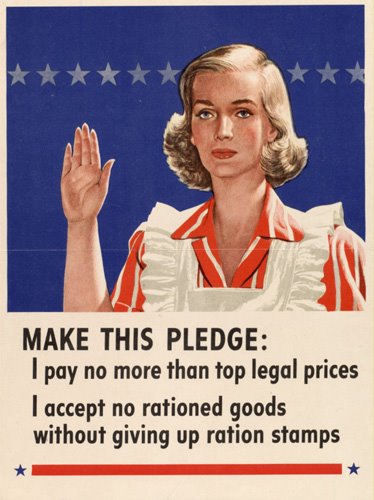
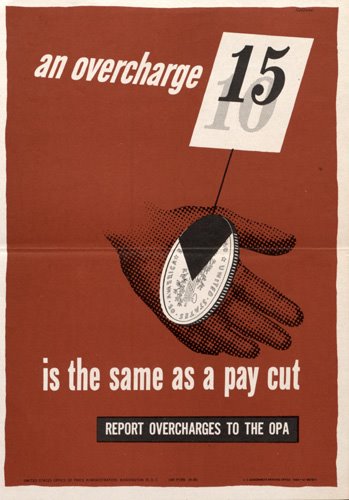
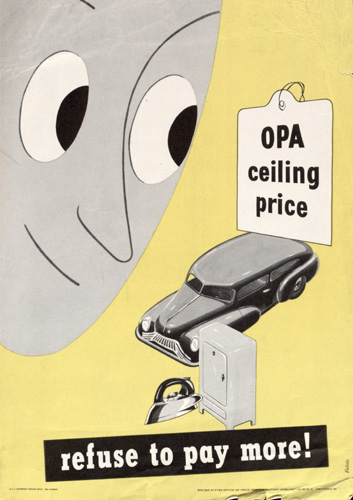
If you hadn't had enough dyspepsia last time; here have some more:

Let's see what we've got here--

Gross caricatures depicting the enemy as subhuman and implicating Americans who ignore wartime edicts as their cohorts...


Check!


Equating downtime for recovery or leisure with active support of an enemy...


Check!


Denigration of those who choose to engage in peaceful, mutually-beneficial exchange as selfish, greedy, unjust lowlifes who help the enemy...


Check!


Discouraging people from maximizing their psychic value, by placing the needs of the war above the desires of individuals as indicated by their market preferences...


Check!


Silly, Norman-Rockwell Americans promoting a variety of harmful and inefficient government schemes...


Check!


Slavery is freedom, free speech is dangerous, non-supporters of the authoritorian regime are going to have a german-speaking group of authoritarians take their place as if it makes a difference...


Check!

Wednesday, November 23, 2005

just a friendly reminder


To those of you out there for which the following is true-- you clap at the movie theatre. Although it may not be apparent, I regret to inform you that the actors who appear on your local cinema screen cannot see or hear you. So why the hell is there a signifigant number of you audience members clapping when you see the trailer for Star Wars or some other popular film? Would you do the same thing at home in front of your TV?

Tonight I had the pleasure of seeing the latest Harry Potter film at the Lowes Imax theatre on 68th and Broadway with my darling wife. When the Warner Brothers logo intro'd the film, nearly the entire audience roared with applause. Same thing when the film ended.

What for? I can understand people getting excited, but it's not like there is a receiving party at the other end which can enjoy approval and being appreciated for their effort.

Sports, shows, musicals, comedians, concerts, speeches and other live entertainment are all suitable venues for audience members to display their approval. I'm ambivalent regarding applause upon plane landings, though I can understand it since there are other representitives of the airline, such as the stewardesses, who can be the 'recipients' of the approval for the pilots landing skills.

So stop clapping at the movie theatre already!

Monday, November 21, 2005

cafe hayek on the FDA

Continuing upon their 'abolish the FDA' theme, Cafe Hayek posts Bob Higgs' response to one of the earlier posts:

My favorite bit:
"The FDA is one of the greatest frauds ever perpetrated on the American people. It is a police agency, pure and simple, driven entirely by political motives, yet it constantly harps on, and gains public-relations mileage from, its scientific grounding. We need to keep telling as many people as we can get to listen that the FDA does not do what it claims to do."

Friday, November 18, 2005

complacency kills

I always stress this meme when explaining the unintended consequences of the even most benign-sounding legistlation. As Lisa Casanova said it some time ago on Catallarchy.net:

The FDA should be totally shelved. No one should be in charge of keeping “marginally safe” drugs off the market, since there is really no such thing. There are no safe or unsafe drugs, only the tradeoff of risks and benefits that is unique to each individual making the choice to take the drug.

In a way, I think that abolishing the FDA might make big lawsuits less of a problem. Right now, people have this idea that drug safety is something they don’t need to concern themselves with, because someone else worries about it for them. They think someone is going to magically know alll the risks and benefits of a drug and tell them, “you can take this drug with zero worries. It’s nice and safe. Go ahead and pop that pill!”

Consumers of drugs get the idea that if the drug is on the market, that must be a sign that nothing bad can happen to them if they take it. If something bad does happen, someone must be to blame, since it was the job of somebody else to make sure the drug was safe, and nothing bad should happen to you if you take approved drugs, right?

Right now, people who take drugs that turn out to have serious risks have this attitude that someone let them down by not making sure that the drug they freely chose to take had no risks. Maybe people buying drugs on the market need to adopt more of a mindset of participants in a clinical trial, one of “I’m stepping into the unknown here. Is it worth it to me?”

If people knew that every time they take ANY drug, they are taking a risk (which is the way things really are), then maybe people would give lots more thought to drug safety than they do now, and outside of cases of companies committing fraud or hiding information about risks, it would be harder to blame someone else every time a drug turns out to have ill effects.
There was also an article in Wired magazine, back in December 2004 which promoted the similar concept of road anarchy, in which 'The approach is radically counterintuitive: Build roads that seem dangerous, and they'll be safer.'

The idea behind it was to remove all the safety devices that drivers have come to take for granted and have lulled them into complacency; road stripes, speed signs, demarcated curbs, traffic lights, etc. This reintroduces the drivers to the reality of what their vehicle is truly capable of if mishandled. Drivers tend to drive slower and keep mindful of pedestrians who are walking just a few feet away and whom no longer enjoy the illusion of safety of an elevated curb. The removal of the road stripes makes drivers drive closer to the side than center of the road, because road stripes subconsciously allow them to drive "in their lane" instead of driving safer and closer to the side. The same goes for speed signs -- take them away and the drivers will gauge the risk of high-speed driving, instead of relying on road signs to give them a roundabout figure of the safety margin.

It even seems to encourage greater road cooperation:

Monderman and I stand in silence by the side of the road a few minutes, watching the stream of motorists, cyclists, and pedestrians make their way through the circle, a giant concrete mixing bowl of transport. Somehow it all works. The drivers slow to gauge the intentions of crossing bicyclists and walkers. Negotiations over right-of-way are made through fleeting eye contact. Remarkably, traffic moves smoothly around the circle with hardly a brake screeching, horn honking, or obscene gesture. "I love it!" Monderman says at last. "Pedestrians and cyclists used to avoid this place, but now, as you see, the cars look out for the cyclists, the cyclists look out for the pedestrians, and everyone looks out for each other. You can't expect traffic signs and street markings to encourage that sort of behavior. You have to build it into the design of the road."

If there ever was a great argument for anarchy, this is it.

Thursday, November 10, 2005

gadget of the week

My geekish tendencies have often left me impaired when it comes to all goods gadget, although thank goodness my self-control and good sense kick in and hence I rarely go ahead and splurge.

The first gadget to thus grace this blog and which receives both the dubious honor of my insomnious attention AND my wife's utter despair is the Lightwedge LED booklight which is available in three sizes; original, paperback and mini.


This gadget is really a hit or miss item- reviewers on Amazon are either gung-ho about it, or deplore it. I've been using it for a couple of days now and I can understand what concerned the critics, but I enjoy it none the less.