While it's entirely impossible to quantify and calculate the total cost that government tacks upon society's individuals, Michael S. Rozeff's daily article on LewRockwell.com attempts to give us a very rough, but low-ball estimate of just the monetary costs:
$48 Trillion!
According to Rozeff, that's approximately three times the wealth contained within the stock market that government drains from society. Before one criticizes these numbers, bear in mind that Rozeff acknowledges the impossibility of knowing the cost of those dollars to the individuals they were parted from, and does not attempt to include all the incalculable psychic damage (unhappiness, stress, etc.) due to the existence of the government and its pseudo-regulations.
Monday, February 27, 2006


Tuesday, February 21, 2006
living la vida anarquia
Over a month ago, I wrote a little about seeing our everyday, seemingly statist-ified world in the more pleasing light of anarchy. To briefly quote:
The topic of course is "Do We Ever Really Get Out of Anarchy?", and it goes on to make the case that the idea of government, by its definition does not truly exist, and that our coexistence is but a specific shade of political anarchy.
It's really good stuff, have a look.
Starting from there, I came to see present human existence in a, ahem, state of anarchy. Yes, even with nation states and governments, I still maintain that we have workable anarchy today. This is because anarchy is but the label of the grid I use to perceive the order of reality.I was then overjoyed to see this Mises post discussing an article published in the Summer 1979 issue of the Journal of Libertarian Studies which promises that it "blows apart the way you've seen the world."
When I look through this grid, I see criminal gangs calling themselves governments, who are merely cruel parasites to the human race.
The topic of course is "Do We Ever Really Get Out of Anarchy?", and it goes on to make the case that the idea of government, by its definition does not truly exist, and that our coexistence is but a specific shade of political anarchy.
It's really good stuff, have a look.
Saturday, February 18, 2006
milestoned!

I'm proud to report here, that I have just finished this fine work, hopefully just one among many I will find it in my favor to study.
If there is an initiation or hazing ritual that I must submit to finally join the proud line of the Austrian 'cultists', would someone please show me where to sign?
Friday, February 17, 2006
mirror, mirror on the blog
"Everytime I read one of Iceberg's comments I imagine him in a dark room with the shades drawn sitting among notebook after notebook after notebook after notebook filled with handwritten scribblings...all stacked to the ceiling."
Wow, I'm touched.

Tuesday, February 14, 2006
one bad policy deserves another

The interventionist solution to the eyesore of shortage queues created by the socialist medicine monster: Ban the line forming!
Saturday, February 11, 2006
Do Blondes Prefer Gentlemen?
One of the upsides downsides of studying economics is how it effects your everyday, mundane cogitation. I now find it difficult to refrain from trying to analyze the praxeological underpinnings of even the most bizaare, non-economic related subjects.
Okay, maybe it's not the worst thing that has happened to me!
To illustrate the perfect case, just the other day I was mindlessly staring at a blond haired woman as she strolled by. Immediately what came to mind was a question of why many women like to dye their hair.
Now of course, the action axiom tells us that people act in the intentional expectation that their actions will help them to achieve greater satisfaction.
Okay, how will dyeing one's hair bring about greater satisfaction? I can think of two ways. First, because the individual believes that they look better with this other hair color, and secondly, because the individual is wanting to grab the attention of another with what the individual believes makes them more desirable to the other persons satisfaction.
But then I realized that the second reason must go deeper than that. After all, the woman who dyes her hair to satisfy the desires of men is ultimately doing it for the benefit of herself; that in the hope that some man will notice her and desire her companionship.
Wouldn't this scenario then fall under the dictum of "demand dictating supply"?
Anyway, as I was googling around I found what I thought is an amusing article written by an econometrician trying to gauge the supply and demand schedules of the personal ad marketplace.
Monday, February 06, 2006
the mythological caduceus
Over at the Mises Institute, Robert Murphy explains what libertarians and free market economists mean when they speak of 'the market'.
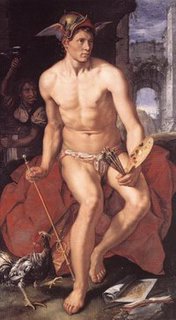 Thus said, people to whom the phrase "free market" means something more than a political catch-phrase, are not worshippers at the temples of Hermes/Mercury nor the secular equivalent. They generally do not subscribe to inexplicable deus ex machina views on market operation, that somehow, someway an incorporeal entity will direct us mere humans to a higher, more satisfying plane of existence.
They may be in fact, scientists of the behavoral science of praxeology, to whom the study and understanding of the human behavior of action is paramount. If they must be said to worship something, it could only be their belief in the general goodness and cooperative nature of the human spirit.
As I've said elsewhere, those who are opposed to the free market are those who hold a dismal view of all of humanity, atrributing malicious and obnoxious behavior as the essense of the man's nature. Ironically, even if such nastiness was the case, the 'free market', which respects the autonomy of individuals would still be the optimal solution for humans of brutish callings. Unfortunately, this dog-eats-dog perception of humanity becomes their paranoid reality, something which I wouldn't wish upon an enemy (which somehow might rationalize his decision to damage my persons.)
As others have pointed out, if the justification for government is based upon the principle that people are naturally evil and dishonest, how could a political system run by individuals comprising of those same values elevate humanity to a better state? One merely needs to study history to see that the one common accomplishment of government has been to institute systematic coercion upon innocents, making their lives worse off in comparison to had the state never existed.
Laissez-faire economists are often accused of "worshipping" market (or what can be called "equilibrium" in the present context, though the two are different) prices. But this is rather misleading. If I oppose murder, it's not because I worship other people's lives. Or, if I don't let my ten-year-old neighbor tinker with my car engine, it's not because I worship its current state. The former case is simply an implication of my views of justice, and the latter case follows from my knowledge that the car works fine right now, and my neighbor's tinkering will only mess it up.
Both aspects lie behind the (natural rights) libertarian's defense of freely floating market prices. On the one hand, if one believes in property rights, then it automatically follows that price controls are immoral. After all, a price control involves the government using its guns to prevent owners from swapping their property at a mutually agreeable price.
But beyond the issue of property rights, there is also the pragmatic aspect. Simply put, if the government sets the legal price below the market level, there will be a shortage; customers will want to buy more units of the good than suppliers will want to sell. There's no way around this: The equilibrium price is that which equates the quantity supplied with the quantity demanded. Left to its own devices, there is every reason to expect a market will tend toward the equilibrium price, although of course it will always be disrupted by changes in the data (supplies, tastes, etc.).
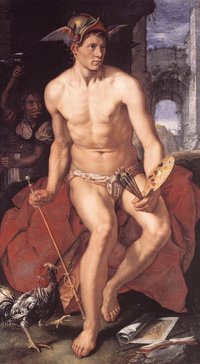 Thus said, people to whom the phrase "free market" means something more than a political catch-phrase, are not worshippers at the temples of Hermes/Mercury nor the secular equivalent. They generally do not subscribe to inexplicable deus ex machina views on market operation, that somehow, someway an incorporeal entity will direct us mere humans to a higher, more satisfying plane of existence.
They may be in fact, scientists of the behavoral science of praxeology, to whom the study and understanding of the human behavior of action is paramount. If they must be said to worship something, it could only be their belief in the general goodness and cooperative nature of the human spirit.
As I've said elsewhere, those who are opposed to the free market are those who hold a dismal view of all of humanity, atrributing malicious and obnoxious behavior as the essense of the man's nature. Ironically, even if such nastiness was the case, the 'free market', which respects the autonomy of individuals would still be the optimal solution for humans of brutish callings. Unfortunately, this dog-eats-dog perception of humanity becomes their paranoid reality, something which I wouldn't wish upon an enemy (which somehow might rationalize his decision to damage my persons.)
As others have pointed out, if the justification for government is based upon the principle that people are naturally evil and dishonest, how could a political system run by individuals comprising of those same values elevate humanity to a better state? One merely needs to study history to see that the one common accomplishment of government has been to institute systematic coercion upon innocents, making their lives worse off in comparison to had the state never existed.
Wednesday, February 01, 2006
this time we really, really mean it

Here is something I thought was a hoot.
The NY Times article is titled "A Retailing Czar, Looking Out for Mom and Pop" and discusses a newly-created and filled bureaucratic position called "executive director of retail development" whose job is ostensibly to help spur retail development around the city.
Anyway, here is the money quote, familiar to those who know anything about the typical government efficiency of utilizing looted capital.
"We've been dividing up the community development corporation money, doling it out a little here and a little there, and it just wasn't helping anyone," said Robert W. Walsh, commissioner of the department. "What's been produced with that money is a lot of calendars, bad directories and tchotchkes. So we hired a specialist to oversee this."
A nagging voice tells me that all NY City will ever get out of this will be yet even more calendars.
Monday, January 30, 2006
a year of blogging
January 30th!
It's hard for me to believe that it's the one year blogiversary for this never-so-humble interweb-log.
My commitment to this blog and the goals thereof remain the same as last year- to further my communication skills, most notably the persuasive and argumentive skillset, which I feel I must do most to improve.
To satisfy the crowd which insists on quantitive metrics: There have been 85 posts to date, a post roughly every four days. When you factor in my downtime to include Saturdays (roughly 52) and other holidays (being stingy I'd say 30 days a year), my post rate climbs to one every 3 days or so.
bartleby the scrivener
I've long been thinking to write about the distinction between the concepts of choice and preference ever since my post on defending the non-abolisionist stance on the alleged subsidy of mortgage interest tax deductions.
Over time I've come across different thoughts, so here they are in no particular order:
 Geoffrey Allan Plauche on the Mises blog who said: [note: some spelling corrections were made]
 So if I'm correctly interpreting what he is saying, choice is an expression of what we think will eventuate the most satisfactory ends, while preferences are simply what we would like our choices to be, regardless of feasibility and may in fact be inconsistent with our desired reality.
For example, my preference to indulge in a diet consisting of nothing but candies and sweets, would be disregarded by choice in light of concerns to my state of health that this preference would endanger.
Now on to the second, which I found a short while ago, Don Boudreaux of Cafe Hayek wrote:
It seems that according to Mssr. Don, preferences are only known through choices, and if one would not choose that preference as an end, it cannot be considered such on its own merit.
Another commenter writes in response:
The perfect example to demonstrate that last example could be a presidential election where there ain't a dimes worth of difference between the nominated bloviated gasbags of scum, and one does not have the choice to say no to both of them.
 If such is the correct interpretation, I would disagree with that last fellow. The reason the "two evils" do not have the third option of 'exit' in such a case is only because free will is being negated. Therefore one cannot be said to either have a choice or subsequently a preference. It's like being presented with the option to be stabbed once or twice, and unless we are dealing with a willing homicide victim or a masochist, there is neither choice of not being stabbed or a true preference of being less stabbed to more stabbed.
But suppose, as I contemplated in another blog article, that the "two evils" we are talking about are those which are inescapable laws of reality:
Over time I've come across different thoughts, so here they are in no particular order:
 Geoffrey Allan Plauche on the Mises blog who said: [note: some spelling corrections were made]
It is implicit in the concept of action that man acts for substitute a more satisfactory state of affairs for a less satisfactory state of affairs. Keep in mind that action implies a means-end framework. Action is performed, the means, in order to attain some end. It is inconceivable that someone would act in order to attain some end that was not preferred in this way.
The obvious objection to this rests upon a failure to consider the relevant alternatives to someone's action. For example, I may prefer reading a good sci-fi novel to grading exams, but my choice to grade exams does not reveal a preference for a less satisfactory state of affairs; rather, I prefer grading exams to being unemployed, destitute, and without the means to purchase my sci-fi novels, among other things.
 So if I'm correctly interpreting what he is saying, choice is an expression of what we think will eventuate the most satisfactory ends, while preferences are simply what we would like our choices to be, regardless of feasibility and may in fact be inconsistent with our desired reality.
For example, my preference to indulge in a diet consisting of nothing but candies and sweets, would be disregarded by choice in light of concerns to my state of health that this preference would endanger.
Now on to the second, which I found a short while ago, Don Boudreaux of Cafe Hayek wrote:
With respect, I respect any preference that reflects a genuine willingness of those with the preference to bear personally all necessary costs to indulge the preference. But I do not respect 'cheap' preferences -- preferences that are merely expressions backed-up with no personal stake in indulging the preferences.
Suppose I invent a machine that allows me to transfer to anyone I wish the ill-consequences of my drinking too much wine...
...But if in the real world -- the world without any such machine -- I tell you "I want to drink every night without limit," what would I mean? If I didn't have personally to bear the costs of drinking heavily I would indeed "want" to do so. But because I do have personally to bear the costs of drinking heavily, in fact I don't want to do so.My saying, in these real-world circumstances, that "I want to drink every night without limit" is nothing more than a loose, slang use of the verb "to want." After all, if I really wanted to drink much more heavily than I now do, I could easily do so. But I never do -- because I am unwilling to bear the awful costs of suffering hangovers and severe risks to my health and career.
The point, in short, is that we use the verb "to want" in very different ways. Some "wants" are worthy and ought to be respected; other "wants" are irresponsible and cavalier -- indeed, not really wants at all.

It seems that according to Mssr. Don, preferences are only known through choices, and if one would not choose that preference as an end, it cannot be considered such on its own merit.
Another commenter writes in response:
Preferences and desires are different things. For example, you might prefer the lesser of two evils but want neither.
The perfect example to demonstrate that last example could be a presidential election where there ain't a dimes worth of difference between the nominated bloviated gasbags of scum, and one does not have the choice to say no to both of them.
 If such is the correct interpretation, I would disagree with that last fellow. The reason the "two evils" do not have the third option of 'exit' in such a case is only because free will is being negated. Therefore one cannot be said to either have a choice or subsequently a preference. It's like being presented with the option to be stabbed once or twice, and unless we are dealing with a willing homicide victim or a masochist, there is neither choice of not being stabbed or a true preference of being less stabbed to more stabbed.
But suppose, as I contemplated in another blog article, that the "two evils" we are talking about are those which are inescapable laws of reality:
Choice is the expression of an individuals free will. One has the free will to makes choices, even in choices which may result in painful conditions. For instance, a person whose appendage is gangrene may have to make the difficult choice of amputation, and being that the nature of the circumstances is not determined in the human realm of action, a person who has to choose between death by infection or amputation of a limb is still making a choice, however difficult.Ok, so may I ask what you all think? Or would you prefer not to? :)
On the other hand, a person who is told to choose between "your money or your life" did not make a choice when he hands the robber his wallet, since the false dichotomy of choice is only the result of the robbers actions fostered against the victim. The robber whom is later caught cannot claim that the wallet's former owner gave his possession of it willingly, and of his own choice. This is what a statist wants you to believe-- that your choice to not pick up and move elsewhere is a expression of your true choice and an express willingness to participate in the political system to which one is subject.
Sunday, January 29, 2006
Constitution?! What constitution?
Some anonymous fellow left me a comment saying how I'm wrong about the eminent domain issue going on in Brooklyn.
Geez, the state is a criminal organization; is there a legitimate instance when its power is not an abuse? If you do think so, that is like saying the mafia has a legitimate business of killing rival gang members.
Has this constitution contract protected any property owners lately? So why do you prostrate your life before it like its your supreme being?
Why do you continue to foster any significance to it in face of everything it is being used to abuse? Why do you think that the judiciary, whom after all are political appointees will rule in your favor against the politicians who put them in power?
So who is the sane one here? The anarchist, or the guy who thinks if we just fight hard enough, the criminals will really, really care about the little guys this time.
when the state abuses its powers, its wrong. period.
Geez, the state is a criminal organization; is there a legitimate instance when its power is not an abuse? If you do think so, that is like saying the mafia has a legitimate business of killing rival gang members.
the use of eminent domain for Ratner's project is unConstitutional (that will be shown in court) and immoral (that has been shown for more than two years now)I'm sorry, there is something called a constitution? I wasn't aware of any contracts that I agreed to abide by.
Has this constitution contract protected any property owners lately? So why do you prostrate your life before it like its your supreme being?
Why do you continue to foster any significance to it in face of everything it is being used to abuse? Why do you think that the judiciary, whom after all are political appointees will rule in your favor against the politicians who put them in power?
So who is the sane one here? The anarchist, or the guy who thinks if we just fight hard enough, the criminals will really, really care about the little guys this time.
Monday, January 23, 2006
blogging
...is hard work.
While I'm never short of ideas, I've been having some stylistic issues in subject presentation.
Stay tuned.
While I'm never short of ideas, I've been having some stylistic issues in subject presentation.
Stay tuned.
Saturday, January 14, 2006
commute with rothbard
If your daily situation resembles my own, hefting the Man, Economy & State, Power and Markets tome to read during your work/home commute is not a viable option. Well, that was until now.
 At this past CES show, Sony has just announced their next generation ebook reader, called simply enough, the "Sony Reader". While this is their second attempt at selling an ebook reader, this time around they are utilizing a technology known as e-ink, which finally delivers a reading experience with the legibility of paper, something that current LCD technology cannot match.
What I like about this, is that for me, it opens up a new paradigm of "commutable" reading materials, namely those backbreakers which you would have never have dreamed of shlepping along previously.
Sony will be selling ebooks through the Sony Connect store, the Sony answer to Apple's iTunes Music Store. The only downside I can see here is that the price of an ebook will not be significantly cheaper than the Gutenberg edition. The aspiring economist within me questions which consumer would be willing to equate the objective use-value of a good which has very little cost to duplicate and transport (an ebook) to that of the physical product, which is still a higher-order good in the warehouse, transformed into a consumer good only after it has been transported into consumers hands. Thus I cannot understand how Sony can equate the price of an ebook in Kansas to that of a physical book in New York, for anyone familiar with Rothbard's example of production costs of wheat (page 622 in MES.)
 To counter that though, it supports other ebook formats such as PDF, HTML, or even just 'plaintext', so if you have the know-how to obtain ebooks illicitly, you won't be lacking in inexpensive ebooks. In any case, organizations such as the Mises Insitute have a vast library of free ebooks, including those such as LvM's Human Action, and MNR's Man Economy & State.
The H x W dimensions are similar to those of a paperback book, while only .5 inches thick and the battery life will give you about 7,500 page turns, enough to satisfy even the most serious reader. My only other qualm with this device is the lack of internal backlighting, quashing dreams of the ideal bedside reading experience.
 At this past CES show, Sony has just announced their next generation ebook reader, called simply enough, the "Sony Reader". While this is their second attempt at selling an ebook reader, this time around they are utilizing a technology known as e-ink, which finally delivers a reading experience with the legibility of paper, something that current LCD technology cannot match.
What I like about this, is that for me, it opens up a new paradigm of "commutable" reading materials, namely those backbreakers which you would have never have dreamed of shlepping along previously.
Sony will be selling ebooks through the Sony Connect store, the Sony answer to Apple's iTunes Music Store. The only downside I can see here is that the price of an ebook will not be significantly cheaper than the Gutenberg edition. The aspiring economist within me questions which consumer would be willing to equate the objective use-value of a good which has very little cost to duplicate and transport (an ebook) to that of the physical product, which is still a higher-order good in the warehouse, transformed into a consumer good only after it has been transported into consumers hands. Thus I cannot understand how Sony can equate the price of an ebook in Kansas to that of a physical book in New York, for anyone familiar with Rothbard's example of production costs of wheat (page 622 in MES.)
 To counter that though, it supports other ebook formats such as PDF, HTML, or even just 'plaintext', so if you have the know-how to obtain ebooks illicitly, you won't be lacking in inexpensive ebooks. In any case, organizations such as the Mises Insitute have a vast library of free ebooks, including those such as LvM's Human Action, and MNR's Man Economy & State.
The H x W dimensions are similar to those of a paperback book, while only .5 inches thick and the battery life will give you about 7,500 page turns, enough to satisfy even the most serious reader. My only other qualm with this device is the lack of internal backlighting, quashing dreams of the ideal bedside reading experience.
Monday, January 09, 2006
talmudic values

During a recent studying session on Tractate Avodah Zara, I came across a dialogue which I think may belie the Talmud's opinion over whether costs determine prices or vice versa. On Daf 7a, the Talmud brings down an argument between Rabbi Meir and Rabbi Yehuda Hanasi (also the author of the Mishnayot upon which the Talmud is based).
The case is where an individual brings a woolen clothing article to a dyer, to be dyed black and the dyer instead dyes it red (or vice versa). No matter if the dyers actions were intended or not, everyone agrees that the dyer is considered a thief and must therefore remunerate the owner; the Tanaic dispute is over the method.
Rabbi Meir says that the dyer only pays the owner the full value of an unaltered cloth, thereby purchasing the article and any improvement. If the dyer believes there is profit to be gained if it's sold, he can potentially profit from his misdeed after selling it on the marketplace.
Rabbi Yehuda Hanasi disagrees and says that the dyer should not gain from his actions. First, he must therefore return the cloth to the owner. Second,
...if the improvement is greater than the expenses, [the cloth's owner] pays [the dyer for] the expenses [of mis-dying it]
And if the expenses are greater than the improvement, [the cloth's owner] pays him for the difference of the improvement [over the value of the original article]...

In the first scenario, the misdyed article will command a premium on the market in contrast to the article they initially agreed upon. Now although the owner was willing to pay X for it to be dyed one color, he finds that he can sell it for a greater sum of Y due to the misdye. In this case he pays the dyer for the expenses of his dying materials, and the labor costs. Even if they initially agreed upon above-market wages for the dying labor, the cloth owner is now only obliged to pay the normal market wages for such labor. (There is hardship on the cloth owner too; he loses time when he goes yet another time to obtain a correctly dyed cloth, he loses time when he has to take the misdye and market it.)
In the second scenario, the commissioned article would command a premium on the market in contrast to the misdyed article that was delivered. Also, the expenses incurred by the dyer exceeded the market price set for the misdyed article. In such a situation, the owner takes the cloth, pays the dyer the difference between the original article and its improvement, thus leaving the dyer to eat the loss for his expenses. (There is hardship on the cloth owner here too; he loses his time when he goes to obtain a correctly dyed cloth, and not only does he lose time in the marketing process, but he is short for the amount that he paid the dyer until the good is sold, and only then does he break even!)
Now what I'd like to know is if this Talmudic passage is implicitly rejecting the Labor/Production Theory of Value (or for that matter any theory that says that costs determine prices) since in both scenarios the Talmud accepts the notion that the price of an article is determined by looking at the marketplace- where transactions will tell us the price of any given consumer good, instead of focusing on the cost inputs of the production process, which in any given case might exceed or fall short of what shall be the market price.
Any thoughts?
Thursday, January 05, 2006
the cup of anarchy is half full
Over the summer I read Robert A. Wilson's Illuminatus! Trilogy; sometimes laughing, at times befuddled, however to a degree enlightened; or if I was to make a bad pun, illuminated.
Among other concepts, the one I find with lasting impression is R.A. Wilson's almost fanatical passion in deconstructing the illusion of having an objective definition of order and disorder. With his introduction to the erisian philosophy, I became acquainted with it's discordian scriptures.
Hence, to quote from the Principia Discordia:
When one advocates for anarchy, the interlocutor he is trying to persuade will usually have already made up his mind about the subject; "Anarchy is equal to chaos, and chaos equals evil, thus using the transitive property, anarchy is unworkable and bad, QED".
The first thing I must object to is the conflation of the terms anarchy and chaos. When I say I desire anarchy, my definition of anarchy means that no one or no group has the legitimacy to initiate force or coercion against an individual. I am of course using anarchy in the original, and primitive sense; an - 'without' + arkhos 'chief, ruler'. That is all there is to it- anarchy does not advocate violent workers uprisings and a reign of terror upon landlords.
It can be fun; when you and your friends play a pickup game of basketball, that is anarchy. It can be mutually beneficial; when one participates in peaceful voluntary exchange, that is anarchy. It can even be romantic; when an individual finds love in others, that is anarchy.
 Starting from there, I came to see present human existence in a, ahem, state of anarchy. Yes, even with nation states and governments, I still maintain that we have workable anarchy today. This is because anarchy is but the label of the grid I use to perceive the order of reality.
When I look through this grid, I see criminal gangs calling themselves governments, who are merely cruel parasites to the human race. (Yes, indeed parasites, because only criminals and parasites think in terms of Laffer curves, which is the government equivalent to a parasite not wanting to kill off its host.) Since my grid lacks distinction for so-called legitimate instances for initiated force, my worldview can be said to be more black-and-white, and simpler compared to the grayscale intricacies of the worldview of one who is less principled when it comes to the application of coercion.
But lets get back to the interlocutors' argument.
Secondly, I object to the conflation of the terms chaos and disorder. Chaos is the natural state of existence, which cannot be said to be inherently good nor bad. However to an individual, some formations of chaos are more useful than others, and hence more valuable and desired. What we call order is our mind creating a construct saying "I enjoy having nature patterned in this fashion, because I derive more pleasure from it being this way". Disorder is when we find that we do not like the formation of the chaos and we declare it displeasing or wrong.
Thus when we examine the claim that "anarchy equals chaos", it then appears to be quite benign in itself. Although it may appear as though anarchy lacks apparent order, this is only true when viewed through the grid called state. If there was then one thing I learned about this grid, it exposes the desire for societal relationships to be ordered on the basis of a punitive disincentives (which I think can be said to be Lockean analysis every bit as much as a Hobbesian one.)
So to conclude I would venture that there is no reason for an everyday anarchist to object to people desiring ordered lives; the main issue arises when a criminal group wants to effect their subjective determination of what constitutes order, and to impose that indifferent to the desires of other individuals.
Viva La Anarquia!
Among other concepts, the one I find with lasting impression is R.A. Wilson's almost fanatical passion in deconstructing the illusion of having an objective definition of order and disorder. With his introduction to the erisian philosophy, I became acquainted with it's discordian scriptures.
Hence, to quote from the Principia Discordia:
The Aneristic Principle is that of APPARENT ORDER; the Eristic Principle is that of APPARENT DISORDER. Both order and disorder are man made concepts and are artificial divisions of PURE CHAOS, which is a level deeper than is the level of distinction making.Hold on to that thought for just a second.
With our concept making apparatus called "mind" we look at reality through the ideas-about-reality which our cultures give us.
The ideas-about-reality are mistakenly labeled "reality" and unenlightened people are forever perplexed by the fact that other people, especially other cultures, see "reality" differently.
It is only the ideas-about-reality which differ. Real (capital-T True) reality is a level deeper than is the level of concept.
We look at the world through windows on which have been drawn grids (concepts). Different philosophies use different grids. A culture is a group of people with rather similar grids. Through a window we view chaos, and relate it to the points on our grid, and thereby understand it. The ORDER is in the GRID. That is the Aneristic Principle.
Western philosophy is traditionally concerned with contrasting one grid with another grid, and amending grids in hopes of finding a perfect one that will account for all reality and will, hence, (say unenlightened westerners) be True. This is illusory; it is what we Erisians call the ANERISTIC ILLUSION. Some grids can be more useful than others, some more beautiful than others, some more pleasant than others, etc., but none can be more True than any other.
DISORDER is simply unrelated information viewed through some particular grid. But, like "relation", no-relation is a concept. Male, like female, is an idea about sex. To say that male-ness is "absence of female-ness", or vice versa, is a matter of definition and metaphysically arbitrary. The artificial concept of no-relation is the Eristic Principle.
The belief that "order is true" and disorder is false or somehow wrong, is the Aneristic Illusion. To say the same of disorder, is the Eristic Illusion.
The point is that (little-t) truth is a matter of definition relative to the grid one is using at the moment, and that (capital-T) Truth, metaphysical reality, is irrelevant to grids entirely. Pick a grid, and through it some chaos appears ordered and some appears disordered. Pick another grid, and the same chaos will appear differently ordered and disordered.
When one advocates for anarchy, the interlocutor he is trying to persuade will usually have already made up his mind about the subject; "Anarchy is equal to chaos, and chaos equals evil, thus using the transitive property, anarchy is unworkable and bad, QED".
The first thing I must object to is the conflation of the terms anarchy and chaos. When I say I desire anarchy, my definition of anarchy means that no one or no group has the legitimacy to initiate force or coercion against an individual. I am of course using anarchy in the original, and primitive sense; an - 'without' + arkhos 'chief, ruler'. That is all there is to it- anarchy does not advocate violent workers uprisings and a reign of terror upon landlords.
It can be fun; when you and your friends play a pickup game of basketball, that is anarchy. It can be mutually beneficial; when one participates in peaceful voluntary exchange, that is anarchy. It can even be romantic; when an individual finds love in others, that is anarchy.
Starting from there, I came to see present human existence in a, ahem, state of anarchy. Yes, even with nation states and governments, I still maintain that we have workable anarchy today. This is because anarchy is but the label of the grid I use to perceive the order of reality.When I look through this grid, I see criminal gangs calling themselves governments, who are merely cruel parasites to the human race. (Yes, indeed parasites, because only criminals and parasites think in terms of Laffer curves, which is the government equivalent to a parasite not wanting to kill off its host.) Since my grid lacks distinction for so-called legitimate instances for initiated force, my worldview can be said to be more black-and-white, and simpler compared to the grayscale intricacies of the worldview of one who is less principled when it comes to the application of coercion.
But lets get back to the interlocutors' argument.
Secondly, I object to the conflation of the terms chaos and disorder. Chaos is the natural state of existence, which cannot be said to be inherently good nor bad. However to an individual, some formations of chaos are more useful than others, and hence more valuable and desired. What we call order is our mind creating a construct saying "I enjoy having nature patterned in this fashion, because I derive more pleasure from it being this way". Disorder is when we find that we do not like the formation of the chaos and we declare it displeasing or wrong.
Thus when we examine the claim that "anarchy equals chaos", it then appears to be quite benign in itself. Although it may appear as though anarchy lacks apparent order, this is only true when viewed through the grid called state. If there was then one thing I learned about this grid, it exposes the desire for societal relationships to be ordered on the basis of a punitive disincentives (which I think can be said to be Lockean analysis every bit as much as a Hobbesian one.)
So to conclude I would venture that there is no reason for an everyday anarchist to object to people desiring ordered lives; the main issue arises when a criminal group wants to effect their subjective determination of what constitutes order, and to impose that indifferent to the desires of other individuals.
Viva La Anarquia!
Subscribe to:
Posts (Atom)


 Posts


