To those within the halls of government power and her intellectual whores within the state-subsidized ivory towers, I hereby beseech your help in removing the difficulties that make life nasty, brutish, short, and generally uneasy.
Just like by the stroke of pen you create wealth, affordable homes, good paying jobs, eliminate poverty and hunger, et. al., I humbly request that you grant us some relatively easier boons.
First, as you may already know, NYC has a serious vermin problem. Please, if you would only pick up your quill and draft a law to ban all forms of vermin within city limits all our problems would go away by fiat, and they wouldn't dare disobey your holy writ.
Also, so many people die from cancers and vascular ailments- can't you ban those horrible illnesses too? It would be so much simpler than just banning the use of trans-fats as NYC just has, and would resolve our health problems immediately. If we just ban obesity, we will witness a transformation as suddenly our cities will feel roomier than before, the train less crowded, the streets easier to navigate, and everyone will trade in their cavernous SUV for some smaller hybrid car.
While you're at it, can you just ban all death, you know, like declare a moratorium on all forms of dying, which we all know does serious economic harm, tears families apart in bitter inheritance lawsuits, and is the greatest cause of involuntary widowhood. This will also greatly help raise the general living standards because people will no longer invest in life or health insurance and would be able to put that money to better, higher uses.
Why stop there? Let's ban divorces, which tie up our family court resources with puerile "he said, she said" controversy. If we ban childish bad behavior, our schools will be able to do their jobs and teach our children properly. We might enact a similar law which will make our students smarter by making it a crime to get anything less than an A+ on a test.
Let's join together to ban Co2-spewing volcanoes so we can end the rapid climate change that threatens to wreck our planet and drown our cities. At the same time, we should ban the ocean from tidal waves, and the winds from blowing devastating hurricanes, monsoons, and tornadoes.
I know that it seems might a lot to ask, but if all it costs is some ink and paper, couldn't you just conjure those up too?
Tuesday, December 05, 2006


Tuesday, November 28, 2006
fractional musings
Here is a question I pose to the more accountant-minded individuals out there-- does the policy of fractional reserve subsidize bank promotions? For example, if a bank offers you $100 to open a checking account with them, is this promotion somehow subsidized by the fact that your $100 promotional gift redeposited into the new account is worth another $900 to the bank in loanable funds?
My first question is then, why does the bank need to give the money to the customer in the first place, instead of "depositing" it themselves, and reaping the full benefit. Then again, I'm not an accountant, nor a banker, so I don't know if these funds are coming from bank profits or from another depositors account, and if from the latter, I would think would just be a wash as far as the total loanable funds and gain the bank perhaps nothing besides another customer.
Can someone help me shed some light on this question?
My first question is then, why does the bank need to give the money to the customer in the first place, instead of "depositing" it themselves, and reaping the full benefit. Then again, I'm not an accountant, nor a banker, so I don't know if these funds are coming from bank profits or from another depositors account, and if from the latter, I would think would just be a wash as far as the total loanable funds and gain the bank perhaps nothing besides another customer.
Can someone help me shed some light on this question?
Sunday, November 26, 2006
styrofoam houses
Back in April, I blogged about the false assertion of market failure.
More recently though, I came across Prof. Hans-Hermann Hoppe's analysis of public vs. private goods in which he thoroughly ridicules the conceptual distinction.
For one thing, to come to the conclusion that the state has to provide public goods that otherwise would not be produced, one must smuggle a norm into one’s chain of reasoning. Otherwise, from the statement that be cause of some special characteristics of theirs certain goods would not be produced, one could never reach the conclusion that these goods should be produced. But with a norm required to justify their conclusion, the public goods theorists clearly have left the bounds of economics as a positive, wertfrei science. Instead they have transgressed into the field of morals or ethics, and hence one would expect to be offered a theory of ethics as a cognitive discipline in order for them to legitimately do what they are doing and to justifiably derive the conclusion that they actually derive. But it can hardly be stressed enough that nowhere in the public goods theory literature can there be found anything that even faintly resembles such a cognitive theory of ethics. Thus it must be stated at the outset, that the public goods theorists are misusing whatever prestige they might have as positive economists for pronouncements on matters on which, as their own writings indicate, they have no authority whatsoever. Perhaps, though, they have stumbled on something correct by accident, without supporting it with an elaborate moral theory? It becomes apparent that nothing could be further from the truth as soon as one explicitly formulates the norm that would be needed to arrive at the above-mentioned conclusion about the state’s having to assist in the provision of public goods. The norm required to reach the above conclusion is this: whenever it can somehow be proven that the production of a particular good or service has a positive effect on someone but would not be produced at all, or would not be produced in a definite quantity or quality unless others participated in its financing, then the use of aggressive violence against these persons is allowed, either directly or indirectly with the help of the state, and these persons may be forced to share in the necessary financial burden. It does not need much comment to show that chaos would result from implementing this rule, as it amounts to saying that everyone can aggress against everyone else whenever he feels like it.
I thought it worthwhile to bring up again, because to my surprise I have learned that builders have found it economical to construct homes with styrofoam blocks, and poof! - there goes one ridiculous example of market failure!Monday, April 17, 2006
the free market fails to fail
One often hears of the term "market failure" as an excuse for unbridled statist aggression to rob, plunder and steal from herslavesunwilling servant class. It might be used to justify environmental policy; to fund canal digging; bridge, road, and railroad building; etc.
Alas, "there is no such thing as market failure - only lack of private property rights." Hence, externalities are the creature of the mixed markets, those in which government has preempted the common law of liability, with its own ineffective policies, in which some cases is a form of corporate welfare (logging industry, fishing rights, etc.)
Without delving further into the economics though, I'd like to state that such a claim is prima facie fallacious because the very notion that there exists an objective definition of what services and goods that billions of interacting individuals ought to offer one another is preposterous. If that weren't true, I humbly submit that there is a market failure to deliver styrofoam houses, bicycles made from gold, and teleportation machines.Thus said, there is no market failure because one cannot argue that such goods or services ought to be provided by the market, only that they, strictly on a personal basis desire the provision to be made.

More recently though, I came across Prof. Hans-Hermann Hoppe's analysis of public vs. private goods in which he thoroughly ridicules the conceptual distinction.
For one thing, to come to the conclusion that the state has to provide public goods that otherwise would not be produced, one must smuggle a norm into one’s chain of reasoning. Otherwise, from the statement that be cause of some special characteristics of theirs certain goods would not be produced, one could never reach the conclusion that these goods should be produced.
But with a norm required to justify their conclusion, the public goods theorists clearly have left the bounds of economics as a positive, wertfrei science. Instead they have transgressed into the field of morals or ethics, and hence one would expect to be offered a theory of ethics as a cognitive discipline in order for them to legitimately do what they are doing and to justifiably derive the conclusion that they actually derive. But it can hardly be stressed enough that nowhere in the public goods theory literature can there be found anything that even faintly resembles such a cognitive theory of ethics. Thus it must be stated at the outset, that the public goods theorists are misusing whatever prestige they might have as positive economists for pronouncements on matters on which, as their own writings indicate, they have no authority whatsoever. Perhaps, though, they have stumbled on something correct by accident, without supporting it with an elaborate moral theory? It becomes apparent that nothing could be further from the truth as soon as one explicitly formulates the norm that would be needed to arrive at the above-mentioned conclusion about the state’s having to assist in the provision of public goods. The norm required to reach the above conclusion is this: whenever it can somehow be proven that the production of a particular good or service has a positive effect on someone but would not be produced at all, or would not be produced in a definite quantity or quality unless others participated in its financing, then the use of aggressive violence against these persons is allowed, either directly or indirectly with the help of the state, and these persons may be forced to share in the necessary financial burden. It does not need much comment to show that chaos would result from implementing this rule, as it amounts to saying that everyone can aggress against everyone else whenever he feels like it.
Sunday, November 19, 2006
how (not) to end war
Skip M. Oliva reckons that N.Y. Rep. Charles Rangel is trying to enslave American youth under the pretense of helping avoid war, with Rangel's recent bill to reintroduce a national service draft that will indiscriminately target youth of all stripes and persuasions. Per Rangel's tortured logic, politicians would think twice before declaring war since their own relatives will be at risk of conscription.
Skip offers some evidence for his suspicion of Rangel's ulterior motive:
A. The bill won't accomplish what it is set to; in this case to end the drive for war, since the "national service" draft contains such a broad category of possibilities, giving politicians the peace of mind they need to kill other people's children when their own loved one's will be strategically positioned somewhere in the relative safety of National Guard duties :cough: Bush :cough: or some cushy desk job at the National Propaganda Agency.
B. As a few Mises commenters point out, you don't fight the war machine by enabling easier access to unwilling labor assets.
C. As Tarran brilliantly writes there--
Skip offers some evidence for his suspicion of Rangel's ulterior motive:
[Rangel] said having a draft would not necessarily mean everyone called to duty would have to serve. Instead, "young people (would) commit themselves to a couple of years in service to this great republic, whether it's our seaports, our airports, in schools, in hospitals," with a promise of educational benefits at the end of service.Where Señor Oliva doesn't actually finish the complete analysis of Rangel's national enslavement bill, I will.
A. The bill won't accomplish what it is set to; in this case to end the drive for war, since the "national service" draft contains such a broad category of possibilities, giving politicians the peace of mind they need to kill other people's children when their own loved one's will be strategically positioned somewhere in the relative safety of National Guard duties :cough: Bush :cough: or some cushy desk job at the National Propaganda Agency.
B. As a few Mises commenters point out, you don't fight the war machine by enabling easier access to unwilling labor assets.
C. As Tarran brilliantly writes there--
Thus we can safely concur with Señor Oliva and conclude that congresscritter Rangel is not looking to end war, but rather sneak involuntary servitude over the great, brainwashed hoi polloi.If you want to give pause to those who wish to start unpopular wars, the answer is not to force people into the military, but to allow those already in the military to leave more easily!
After all, if my employer orders me to go to my competitors offices and break their legs as they come in for work, I don't have to do it, I can say "cheerio" and quit. Soldiers aren't given that option (in fact they are threatened with death for attempting to quit).
Let's give them that option. I think something like changing the rules so that any soldier can quit, anytime, and they get evacuated after the wounded (if the exigencies of the fighting permit), are transferred to the U.S, and honourably discharged.
Thus, every soldier who risks his or her life would not be doing it because they feel they have no choice, but because they feel the risk is worth it. It would blunt the U.S. government's abilities to conduct offensive operations, but would enhance the U.S. government's ability to conduct defensive operations (should the warlike Canadians ever decide invade us).
Friday, November 17, 2006
RIP Milton Friedman
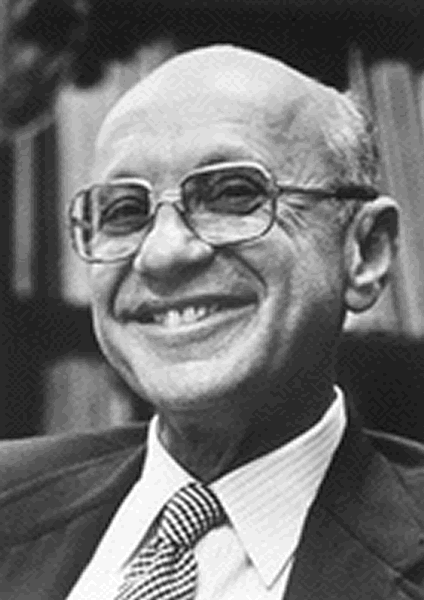
Of the thirty or so articles I've parsed so far, the most lingering and salient point I've gleaned from Milton's life-long (sometimes inconsistent) struggle for individual freedom, is this:
"In the 1970s, he was a leading advocate for the abolition of the military draft. At one hearing, Friedman became annoyed with a general who likened those in an all-volunteer military to ``mercenaries.'' Friedman told the general that if he insisted on using that term, he would liken draftees to ``slaves.'' The general made a rhetorical retreat."
With his razor-sharp wits at his beck and heed, Milton was certainly nobody's monkey.
Monday, November 13, 2006
frist [born] post
It is with great pride and pleasure that I announce to all the finest denizens of the interwebs the birth of my first child, a son.
A special shout-out of gratitude goes out to BK Marcus for all his [unsolicited] advice which is greatly appreciated, as well as the cute baby gifts he sent us.
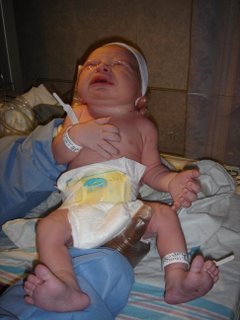


A special shout-out of gratitude goes out to BK Marcus for all his [unsolicited] advice which is greatly appreciated, as well as the cute baby gifts he sent us.



Tuesday, October 17, 2006
perspective matters
 After reading Ken MacLeod's latest book, Learning the World, I found it that it's not exactly what I'd consider a page-turner. However I can relate that his novel took a fresh approach to the old "humans make alien contact" storyline, by presenting it mostly from the POV of the non-homo sapiens.
What makes this book interesting is that MacLeod switches the usual positions of the "us and them", in that the aliens of the novel are us humans, while the aliens being visited are referred to as the humans.
By reversing the positions, MacLeod's story cleverly presents the homo-sapien intergalactic travelers as aliens to the readers, which is made all the more-so believable because their behavior and culture is seen as strange, so distant, and alien to us.
The society of the non-homo sapiens on the other hand, aside from their physical differences, can be easily related to by the reader, because their society is rife with war, slavery, government tyranny, etc. In that sense, the reader is being presented with a subtle slap in the face, perhaps awakening him to see that the values and ideas that most people today consider the virtue of civilization are in fact quite barbaric and uncivilized.
Friday, October 06, 2006
bruce lemmon
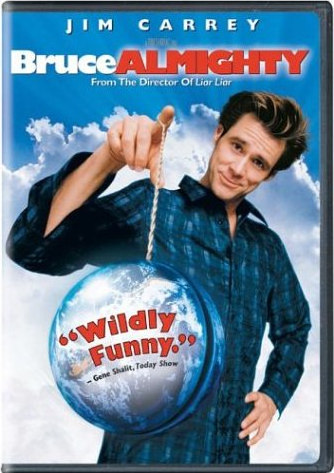
In what must be flattery, who would you guess served as inspiration to actor Jim Carrey's manic character roles?
Now call me crazy, but I'm willing to bet it was Jack Lemmon after recently watching The Apartment. Also starring Shirley MacLaine as Fran the elevator woman, it's about the life of a lowly actuary named C.C. Baxter, played by Lemmon, who is constantly cajoled into lending the use of his apartment to his higher-ups in the company because he can't turn them down.

At first I found it eerie in how similar his body language was to that of Jim Carrey, but I was blown away when he uttered to Fran "That's the way the cookie crumbles" (the trademark phrase have you, from Bruce Almightly starring none other than Jim Carrey.)
 If that wasn't enough, Fran later says "I guess that's the way it crumbles, cookie-wise".
I guess it could all just be some screenwriters joke on ol' Jim though, but I'd like to think that he was in on the laugh. Come to think about it, they even look alike as evidenced in the picture below.

bar none
In response to the constant complain of late-night noise and rowdy drunks, the NY State Liquor Authority, which oversees the issue of liquor licenses has declared a heavy-handed moratorium against the issue of new licenses to any establishment located within a 500 foot vicinity of any other watering hole. This surprise edict has even affected longtime operators who amidst a relocation have found they can no longer serve alcoholic beverages at their new joint.
While this policy will certain bring financial ruin to many an unfortunate business owner, it is hoped that use of this back-door tool of withholding licenses will help the government solve the noise problems and other neighborhood disturbances caused by late-night revelers making their woozy way home at 2 AM.
I'd like to commend and quote an excellent comment made by an astute individual on a Gothamist post on this topic:
While this policy will certain bring financial ruin to many an unfortunate business owner, it is hoped that use of this back-door tool of withholding licenses will help the government solve the noise problems and other neighborhood disturbances caused by late-night revelers making their woozy way home at 2 AM.
I'd like to commend and quote an excellent comment made by an astute individual on a Gothamist post on this topic:
It's the noise and riff-raff that's a problem, not the bars or the booze they serve. Young fools pack into these bars like sardines, and cutting the number of liquor licenses is only going to make the existing places even MORE unbearable than they already are. And they are pretty freaking unbearable already.Welcome my friend to the world of wacky intervention.
Wednesday, October 04, 2006
paper shackles
 Is a contract anything more than the mere semblence of colored atoms contrasted against the surface of another medium, designed in a fashion in which it contains arranged patterns recognizable to humans as the expression of inscrutable thought elements?
If that is so, can we still posit existant duties and enforcability consistent with libertarian application of justice for contracts, whether penned or merely verbally expressed?
I like to think that a contract derives it economic power from the market process, and not from the terms of enforcability and that this would be likewise true of the bonding companies which would serve to protect a system of free contracting.
An individual or firm who failed to meet their contractual duties and/or the bonding company which failed to remunerate the damaged parties would be quickly put out of business.
This is not to say that there could be no foundational ethic to support the rights and enforcabilty measures, but rather one should not have to posit the existence of contractual rights in order to uphold the ideal of free contracting.
Overall I'd like to think that the libertarian justice system can sleep securely, while the benign king of "good will" reigns as the final arbiter over civilzed society.

weapons of mass disillusion
I adore Borat. This HBO comedian should be considered an anarchist hero, even though he probably is not what you and I would call an anarchist. The reason why I nominate him to the hero status is because of the great work he has done to blasphemously pierce the veil of sanctity attached to the state.
I reckon that the reason why he has been more successful in this regard than most others is due to the nature of government; wherein the basis of its power is ultimately derived from public opinion.
Comedy, it seems is a most potent agitant to be used against the state, and when wielded properly can exert more wide-spread influence than a brilliant dissertation on the philosophical foundations for liberty or the ethics of a market economy.
I suspect this would also explain the popularity of Comedy Central's Jon Stewart, who although I imagine is also statist to the core, still manages to disaffect the masses from their illusioned sanctity of government with the potent WMD of comedy.
Tuesday, October 03, 2006
unbound

Just recently I had the privilege to attend a 100th anniversary party held for an apartment building that was constructed by architect Charles A. Platt in the year 1905-1906. Ten of the current residents in this tony building opened their homes to exclusive viewings restricted to the snooty geegawers on the guest list (which admittedly I cannot be found, but my associate who brought me there was.)
After quietly hobnobbing with the stuffy elites -- okay, I think I made my point-- we made quick exit back to real life.
My associate, a fellow statist with an extensive real estate development background was quite astounded at the short timeline in which this building was erected.
From what little I know of New York City history, there was no buildings department back in 1905. There was relatively no zoning codes, no landmarks commission, and generally little government oversight into real estate development. The only regulation I can think of that this building was subject to was a height restriction, as laid down in the "New York Tenement Law" which stated that buildings could not be built higher than 1.5 times the street width. With that one condition, the architect/developer designed an amazing 11-story building which till today is quite unmatched in certain respects.
My associate, although he has yet to shed his statist-informed illusions, is one who was never shy to flirt with the given rules of the officialdom. His business decisions are mostly informed by what he thinks he can get away with, rather than what will be readily praised by the most straight-laced bureaucrat who could care less about your timeframe or budget expenses.
After quickly summing up all the things that slow down our current projects, be it dealing with OSHA, the NYC Building Department, the Landmarks Commission, the Mayors Office (for the issue of getting waivers on ADA compliance not feasible in a landmarked structure which is mostly untouchable to its legal owner), it is no surprise that although our generation is far ahead in terms of technology and construction techniques, we are far behind in terms of where we could have been if the overall regulatory environment had not reared its ugly head over the past century.
Slightly-related fun fact of the day: Kennedy is old Gaelic for "ugly head".
**UPDATE**
Per the NYC Department of Buildings:
"In 1860, after a tenement fire took 20 lives, New York City's building laws were extensively revised and strengthened. At that time, the position of "Superintendent of Buildings" was created within the Fire Department to enforce the new structural safety laws. An independent "Buildings Department" in Manhattan was later founded in 1892. Each Borough President's office had an autonomous Superintendent of Buildings until 1936, when a citywide Department of Buildings was created."
In any case, the avalanche-ish erosion of private property rights could be said to have begun with the Zoning act of 1926, in which the city got the idea that they have the right to dictate property usage types, dimensional and bulk restrictions, and the construction configuration requirements. While it was more lax in the early years, over the century it has started to resemble the old dictum "everything not prohibited is compulsory and everything not compulsory is prohibited."
The Landmark Commission was created in the 70's which marks the begining of statists interfering in purely aesthethic planning. From this point forward, we can expect to see a new government agency, the sole purpose of which will be to render decisions of property aesthethics for non-landmarked neighborhoods or properties, perhaps to enforce the color you will be able to paint your home, regulating the species and allowable dimensions for your landscaping elements, what style of bathroom fixtures are permissible, and if we are very lucky, even the type of screws you will use to build said home.
Lest you think I'm exagerrating, I can assure you that there are many stato-masochists who are already clammering for a "Buildings Design Authority" to be established, and one may proceed to www.wirednewyork.com and search the forums for many such fine examples.
Monday, September 25, 2006
gunshots

I was coming out of the F train on the NW corner of 63rd St, when I heard, rather than saw the accident occur. I then heard someone excitedly yell "He's stabbing him!!" and I looked over as the perp exited his vehicle from the passenger side, and brandishing a knife, starting chasing the cop who was approaching the car door.
Seconds later I see mace spray arcing wildly in the air as the cops retreat from the knife-wielding thug, and a moment later, I hear three gunshots ring out.
The crowd which moments before was gathered around at the corner dispered suddenly, some of them ducking to the ground, most of them running up the block.

And 20 seconds after it all began, there were people who began crying in the street, hugging fellow strangers for moral support.
I'm forever changed.
-WNBC
-1010 WINS
-ABC
Wednesday, September 20, 2006
the money quote
I have perhaps read a fraction of Ludwig von Mises's effusive output, but I have already corrected myself of the initial misconception that Mises wrote punctilious yet boringly dry economic texts. To witness;
 L. v. Mises, Godfather of the Austrian Mafia
"Superficial critics of the capitalistic economic system are in the habit of directing their attacks principally against money... and yet they want this exchange to be achieved without any medium, or at least without a common medium, or money. They obviously regard the use of money as harmful and hope to overcome all social evils by eliminating it...
All the processes of our economic life appear in a monetary guise; and those who do not see beneath the surface of things are only aware of monetary phenomena and remain unconscious of deeper relationships. Money is regarded as the cause of theft and murder, of deception and betrayal. Money is blamed when the prostitute sells her body and when the bribed judge perverts the law. It is money against which the moralist declaims when he wishes to oppose excessive materialism. Significantly enough avarice is called the love of money; and all evil is attributed to it.
The confused and vague nature of such notions as these is obvious. It is not so clear whether it is thought that a return to direct exchange by itself will be able to overcome all the disadvantages of the use of money, or whether it is thought that other reforms will be necessary as well. The world makers and world improvers responsible for these notions feel no obligation to follow up their ideas inexorably to their final consequences. They prefer to call a halt at the point where the difficulties of the problem are just beginning. And this, incidentally, accounts for the longevity of their doctrines; so long as they remain nebulous, they offer nothing for criticism to seize upon."
--The Theory of Money and Credit, Chapter 6
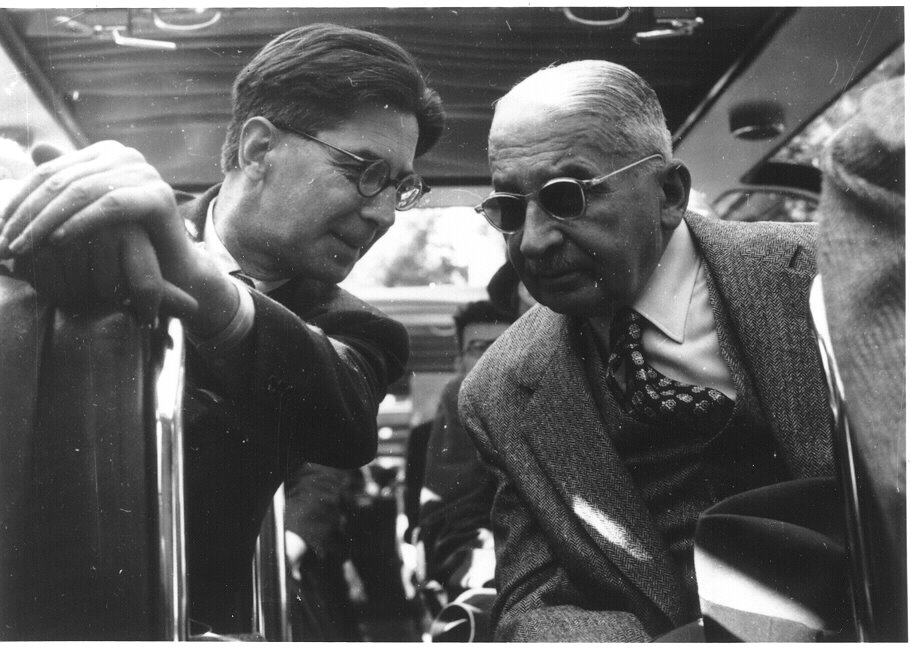 L. v. Mises, Godfather of the Austrian Mafia
Sunday, September 17, 2006
the language coil
I've often found that peoples unknowingly hold thoughts and beliefs which they are bound to by the words and concepts they have used all their life, but pay no more than cursory attention to their meanings. Surely there is a good reason for the usage, as abstractions serve a purpose of both mental and verbal shortcuts, allowing us to quickly express complex thoughts without having to resort to reinventing the wheel every time we need to have a flat tire fixed.
Therein lies the danger-- the assumption that people automatically understands the full meaning of the abstraction, and are not mislead to take the abstraction as a significant term other than the sum of its parts.
One quick example that can demonstrate this point; the use of the words "natural" and "unnatural" used other than to discern between occurrences that come about on their own in accord with the law of nature, and occurrences that come about through the intervention of some higher being, such as man or a supernatural being.
As Vache Folle points out,
Similarly, I have friends who refuse to use microwave ovens, or artificial sweeteners, and I wholly understand this position being that these health-conscious individuals are always looking out for the next bogeyman, in this case the scary terms "radiation" and "artificial" or "synthetic".
It never fails to amaze me how grown, reasoning people can get frightened from the term radiation. After all, every moment of our existence, from start to end is bathed in, and emits radiation. There is the heat radiation our body's give off, the radiation we bask in from the radiator, the sun's light radiation we attune our brains to see with, the infrared our convection ovens cook with, and the TV, radio and cosmic rays that endlessly bombard us, or pass through us without regard to our atomic density.
But set an unnatural magnetron to emit alternating electric currents at 2.450 GHz, fully and benignly enveloped in a Faraday cage, and see how people run to hide to the accustomed and relative safety of Prometheus's fire (which by the way radiates in the infrared range).
I fail to understand why this particular form of radiation is feared more so than other forms, but I'm willing to put myself out there and dare blame it on the abstraction of "radiation". I can also assure you that it's a waste of perfectly good oxygen to try to talk sense into a microphobic by telling him that because the size of the perforations in the mesh is much less than the wavelength of 12 cm, the microwave radiation cannot pass through the door, while visible light (with a much shorter wavelength) can. In this case the abstraction must be clearly defined and explained to break through the paranoia.
In regards to sweeteners of all origins, I have found the aversion to synthetic chemicals to be ill-informed and non-reasoned. First, what is a sweetener? Obviously a sweetener is some chemical formation that interacts with your taste buds in a way that your mind might find enjoyable and pleasing. For a long time, sugars found abundantly in nature have provided that stimulation, with much resulting havoc to the health of those whom have over-consumed.
With the introduction of man-made sweeteners, luddites have found yet another non-sensical distinction to hound to no end. They suddenly become paternalistic scientists, positing such brilliant and hard-hitting questions such as "How do you know it won't give you cancer?" (I often fear that the loathing people have for synthetic sweeteners derives from their gloomy sense of universal justice, as though it cannot be that something tasting so good can dare exist without having a significant unnutritional repercussions.) My usual answer to this nonsense is to ask them how they know the fruit, vegetables, or whatnot that they consume will not give them cancer.
The abstracted assumption I am asked to believe is that a chemical formation which is not found in nature, must automatically be harmful to, and was never meant to be assimilated by the human body. The term that does the brain damage in this case is "artificial"- equated by the luddites to mean "fake", and jeez, fake things must be bad for you. The person who doesn't get caught up with these meaningless distinctions though would be prudent to monitor the effects of, both short and long term, for all types of foods, not just those of unnatural origin.
Frankly I can go on about the knee-jerk aversion to genetically-modified foods, but I think the patient reader has already grasped my point.
Changing Gears
Some while ago, there was heated discussion over the viability of corporations in a free market. The furor started over Piet-Hein Van Eeghen's corporation-scathing JLS article titled "The Clash With Classical Liberal Values and the Negative Consequences for Capitalist Practice".
To summarize, Van Eeghen's arguments boiled down to a few critiques of the injustices of corporations such as: corporations historically relied on a state to give it entity status, they separate control from responsibility (limited liability), they exist independent of human life, and can well exceed it, and are hence essentially state-like in their nature.
To a LeftLibertarian, sometimes the luster of this poison apple has them to cast aside their better judgment as they eagerly denounce all forms of corporations. The problem of course is their inability to overlook the historical, and abstractional association of the term.
Shrugging aside the baggage of positive law, the function of a corporation is a useful abstraction to a free society. For one, it makes a wonderful vehicle to expedite the accumulation of savings necessary to allow production to reach higher, more roundabout stages, which result in prosperity. It also allows those with pressing time constraints to delegate the task of working their otherwise non-productive capital.
The much ballyhooed illegitimacy of the corporations' entity status is as wholly irrelevant, as is the historical fact that corporations were state-granted abstractions. I fail to understand why that should have any bearing on a group of freemen consentually hallucinating the imaginary entity for the unified purpose of filling some productive desire.
Furthermore as I wrote there in separate posts;
What Else?
I imagine that there are hundreds of abstractions that most people hardly think twice about-- the nonsensical basis for intellectual property laws for example. The point I make is only that one should maintain constant guard against accepting the package deal of an unstudied abstraction.
Therein lies the danger-- the assumption that people automatically understands the full meaning of the abstraction, and are not mislead to take the abstraction as a significant term other than the sum of its parts.
One quick example that can demonstrate this point; the use of the words "natural" and "unnatural" used other than to discern between occurrences that come about on their own in accord with the law of nature, and occurrences that come about through the intervention of some higher being, such as man or a supernatural being.
As Vache Folle points out,
"I have known folks who claim that their hatred of homosexuality stems from reason. In support of this, they claim that it is “unnatural”. Since it occurs in nature with some considerable frequency, I dispute this characterization. It is true that homosexuality does not lead to reproduction, but neither does celibacy, and I don’t know anyone who condemns celibacy. Ultimately, this moral reasoning depends on the metaphysical assumptions that “natural” is good and that reproduction is always desirable."Please note how the construct of the abstractive terms "natural" or "unnatural" cast not any moral and ethical judgments such as right and wrong, or good and bad. The association of natural and good, and vice versa is a wholly inappropriate exercise, and ought be corrected where ever visited.
Similarly, I have friends who refuse to use microwave ovens, or artificial sweeteners, and I wholly understand this position being that these health-conscious individuals are always looking out for the next bogeyman, in this case the scary terms "radiation" and "artificial" or "synthetic".
It never fails to amaze me how grown, reasoning people can get frightened from the term radiation. After all, every moment of our existence, from start to end is bathed in, and emits radiation. There is the heat radiation our body's give off, the radiation we bask in from the radiator, the sun's light radiation we attune our brains to see with, the infrared our convection ovens cook with, and the TV, radio and cosmic rays that endlessly bombard us, or pass through us without regard to our atomic density.
But set an unnatural magnetron to emit alternating electric currents at 2.450 GHz, fully and benignly enveloped in a Faraday cage, and see how people run to hide to the accustomed and relative safety of Prometheus's fire (which by the way radiates in the infrared range).
I fail to understand why this particular form of radiation is feared more so than other forms, but I'm willing to put myself out there and dare blame it on the abstraction of "radiation". I can also assure you that it's a waste of perfectly good oxygen to try to talk sense into a microphobic by telling him that because the size of the perforations in the mesh is much less than the wavelength of 12 cm, the microwave radiation cannot pass through the door, while visible light (with a much shorter wavelength) can. In this case the abstraction must be clearly defined and explained to break through the paranoia.
In regards to sweeteners of all origins, I have found the aversion to synthetic chemicals to be ill-informed and non-reasoned. First, what is a sweetener? Obviously a sweetener is some chemical formation that interacts with your taste buds in a way that your mind might find enjoyable and pleasing. For a long time, sugars found abundantly in nature have provided that stimulation, with much resulting havoc to the health of those whom have over-consumed.
With the introduction of man-made sweeteners, luddites have found yet another non-sensical distinction to hound to no end. They suddenly become paternalistic scientists, positing such brilliant and hard-hitting questions such as "How do you know it won't give you cancer?" (I often fear that the loathing people have for synthetic sweeteners derives from their gloomy sense of universal justice, as though it cannot be that something tasting so good can dare exist without having a significant unnutritional repercussions.) My usual answer to this nonsense is to ask them how they know the fruit, vegetables, or whatnot that they consume will not give them cancer.
The abstracted assumption I am asked to believe is that a chemical formation which is not found in nature, must automatically be harmful to, and was never meant to be assimilated by the human body. The term that does the brain damage in this case is "artificial"- equated by the luddites to mean "fake", and jeez, fake things must be bad for you. The person who doesn't get caught up with these meaningless distinctions though would be prudent to monitor the effects of, both short and long term, for all types of foods, not just those of unnatural origin.
Frankly I can go on about the knee-jerk aversion to genetically-modified foods, but I think the patient reader has already grasped my point.
Changing Gears
Some while ago, there was heated discussion over the viability of corporations in a free market. The furor started over Piet-Hein Van Eeghen's corporation-scathing JLS article titled "The Clash With Classical Liberal Values and the Negative Consequences for Capitalist Practice".
To summarize, Van Eeghen's arguments boiled down to a few critiques of the injustices of corporations such as: corporations historically relied on a state to give it entity status, they separate control from responsibility (limited liability), they exist independent of human life, and can well exceed it, and are hence essentially state-like in their nature.
To a LeftLibertarian, sometimes the luster of this poison apple has them to cast aside their better judgment as they eagerly denounce all forms of corporations. The problem of course is their inability to overlook the historical, and abstractional association of the term.
Shrugging aside the baggage of positive law, the function of a corporation is a useful abstraction to a free society. For one, it makes a wonderful vehicle to expedite the accumulation of savings necessary to allow production to reach higher, more roundabout stages, which result in prosperity. It also allows those with pressing time constraints to delegate the task of working their otherwise non-productive capital.
The much ballyhooed illegitimacy of the corporations' entity status is as wholly irrelevant, as is the historical fact that corporations were state-granted abstractions. I fail to understand why that should have any bearing on a group of freemen consentually hallucinating the imaginary entity for the unified purpose of filling some productive desire.
Furthermore as I wrote there in separate posts;
"Entity, or personhood is just an abstraction; a convenient mental construct. Let not the statist baggage cloud the free market variety which could accomplish the same function. The real owners are, and have always been the shareholders"...
"As an addendum, I want to point out that the immortality question isn't an issue once we recognize the shareholders (and to whomever they sell or bequest their property) as the real owners."
"I don't know why you insist on conflating state capitalism's form of corporation, and it's convenient legal fictions, with a free market version which is based on libertarian principles, in which the only recognized form of ownership is clearly vested in the shareholders, and not some fictitious entity.
A corporation under libertarian law would be recognized as a relationship where persons are under the acting orders of the ownership to steward some property, and under which any tort liability would have to be aimed strictly at the parties involved in causing the damages.
Mere ownership of the property does not necessarily include the owner as part of the cause-- to accept otherwise would be a knee-jerk response by someone who only recognizes the whole package deal of state-capitalism's corporatism"...
"I have no disagreement here, other than I would think that under anarchy people would be free to form voluntary arrangements, for example to live communally under socialist principles.
Such society would allow people to suffer the illusion of having a distinct personhood for fictional entities, something that some might say we have that today with the concept of god as expressed by religion.
Of course such illusions will be strictly subjective to that group, and any other individual or group dealing with the corporation would deal with it's owners or management under the libertarian condition of determining causation."
What Else?
I imagine that there are hundreds of abstractions that most people hardly think twice about-- the nonsensical basis for intellectual property laws for example. The point I make is only that one should maintain constant guard against accepting the package deal of an unstudied abstraction.
Subscribe to:
Posts (Atom)


 Posts
Posts


