Monday, August 28, 2006

when logic need not apply

Some people just don't get it-- and this is not just anyone, it's a blog written by one of the most respected property appraisers in New York City, who you would think would know, well you know, about property values, and the formation of prices in general.

According to his foolish naïveté, it's the housing boom that drives the middle class out of the city, not misguided market intervention (which is a truely understandable conclusion for an empiracist who illogically correlates a boom in the housing supply with the exodus of middle class workers and deduces that an increased supply of a good = higher prices).

Go figure.

Below are the comments I left this wunderkind.
"This is one of the byproducts of the housing boom and revitalization of urban areas."

That dog won't hunt.

This is a direct product of people naively believing in the Central Planning Fairy.

The main reason why middle class incomed people are being priced out of the cities is tri-fold:

The primary problem is the irrational belief in the goodness of centrally planned zoning; that which dictates the density, dimensional proportion, usage type, etc. allowed. Of course planners are only human, so they cannot fully forsee all the long-ranging effects of their economic devestation and class-polarity housing policies.

The act of zoning is the grand pretense that experts have the right and privilege to tell you what is good for you, Citizen Joe, as though Joe would not have common sense enough to not live in unlivable living conditions.

It thus serves to stifle development of all kind, leaving unmet demand at all price levels, but most especially the middle and lower price ranges.

Think about it, because it's purely logical. If you restrict availablity of any given product, the price will rise as people will bid up prices. Those who cannot afford to bid higher must seek alternatives. Those alternatives include finding housing in less desired areas, and maybe even out of state.

Essentially, zoning thus serves to raise the price of housing by restricting competition. When private organizations engage in this activity, it is known as cartelization and angrily condemned. But when pretensious city planners do it, they are met with celebration as anybody can attest about the shameful participation and agitation by groups such as ACORN or the GVHPS.

Secondarily, the white collar workers are the direct victims of the price war, as they cannot bid away the same quality housing as the rich, and they must live in inferior housing, less choice neighborhoods, etc.

But tertiary, and most insultingly, the white collar workers are the ones subsidizing the lower classes, who thru the mechanizations of the city and state (such as Section 8, HUD, and rent control/stabilization, and IMD regulations*), end up bidding away the housing with the middle classes' money!

So in the end, the white collar worker are the rat which gets chopped from both ends-- the rich can afford the higher prices (and might even prefer the exclusivity the housing shortage provides), and the lower class uses the middle classes redistributed money to buy up the lower end product. It's no wonder the middle class are "fleeing", as they are not in any politicians grace to not be plundered.

The definition of insanity is to continue to act in a manner which is detrimental to your well being, because only the insane repeat the same actions and expect different and better results each time around.

Alternativly, we can pull our heads out of the sand and abandon these puerile fantasies of "smart", managed growth, and leave it to the wisdom of the common individual to decide how tall is too tall, how dense is too dense, etc.

* This was introduced into the blog post for the sake of clarity and does not appear in the original comment.

swait and bitch

In an article deceptively titled "The Worker's Rights Manifesto" (via Digg.com), KAZ lays out a libertarian approach to protecting the proletariat class interests.
You and I, as a workers, have certain rights which are naturally ours, and which nobody should be allowed to take away from us. These rights are choices we are free to make, unless the powerful decide to steal them from us.
  1. The right to work for the amount we choose.

    What we earn should be a matter between ourselves and our employers, not something controlled or approved by some government, union boss, or other busy-body.
  2. The right to work for whom we choose.

    Where we work should be a matter of which job offer we accept, not controlled by some law or union rule saying that we are the wrong race, or sex, or what someone with our amount of experience is allowed to do.
  3. The right to keep the product of our labor, and do with it as we choose.

    The product of our labour is the amount we agree to sell our services to an employer for. It is ours by right, and any authority who takes it from us for their own purposes is wrong, be it taxes or union dues. Having earned it, we have a right to keep it even if we change its form, by buying something with it or willing it to our heirs.
  4. The right to decide how we work.

    What if we don't want three weeks off, but would like a little extra pay, instead? What if we want to buy health insurance with a huge deductible for two hundred bucks a year, instead of paying two hundred bucks per month for full insurance, because we have a lot saved up in the bank in case I get sick? Nobody should be able to bully us, with tax "incentives", regulations, or collective bargaining contracts, into taking a generic benefits package that has stuff we don't need, instead of the money or benefits I would prefer.
  5. The right to work the way we choose.

    We have a right to decide what is "safe", for ourselves, instead of being locked into some instantly-outdated and rigid "standard". We likewise have the right to decide what way to do things, and again not be shackled by red tape and rules invented by some bureaucracy.
  6. The right to become owners / management, and be proud of it.

    If we work hard, and make the sacrifice of saving our rightful income (product of labor), or work in our own time to create a great new idea, we have a right to invest it to create new wealth, becoming an owner, and not be punished for it, or looked down upon as something other than a worker.

Thursday, August 24, 2006

suprise suprise

"More tellingly, it provides a case study in what happens when competitive forces are unleashed and markets are allowed to operate more freely. And while some drivers are worse off, the vast majority of consumers have gained from the changes... Insurance regulators say more than 75 percent of New Jersey’s drivers are now paying less for auto insurance and that further reductions are expected...

Since the mid-70’s, auto insurance prices in New Jersey had been higher than anywhere else in the country. But even so, insurers contended that they could not turn a profit.

Trying to keep insurance affordable and available, officials layered on regulations. With competition limited, lower-cost insurers simply avoided the state.
"
No, that's not from a daily article on the Mises blog; would you believe it's actually in the NY Times? (and it's not written by John Tierney)


This good news comes after years of stifling regulation designed to "save" the lowly consumer from the depradations of the auto insurance industry.

Here is another interesting quote:
"As voters complained to lawmakers, regulators made it more difficult for insurers to raise rates. One consequence was that in good years insurers held off from requesting lower rates for fear that when their fortunes turned, they would not be permitted to reverse the process."
Which goes to demonstrate a number of things:

1) The ballot method is vastly inferior to the market process, where each dollar is the consumers' vote to reward the efficient producers and penalize the less efficient ones. This insurance issue has been around from before I was even a remote assembalance of atoms. The market on the other hand has delivered an equitable solution in less than one year's time.

2) The political solution almost always leads to an even less efficient situation whilst decreasing the choices and freedoms of individuals and increasing the power of regulators.

3) That individuals whose freedoms are constrained are bound to act in the manner of erring on the side of caution, leading to even greater inefficiencies. For example, NJ gas stations are allowed by law only one price change per day (once per week if located on the highways), and will thus tend to pricing their gas higher than the expected replacement cost, rather than take the risk of offering an unmutable lower price and not being able to afford the next delivery. Had the state not interfered, they would intially price their gas at what they believe will be sufficient to cover replacement costs, and upon better information, they will raise or lower their prices accordingly.

4) The regulatory hell had pretty much cartelized the industry to a select few players -- exactly two, if I remember correctly.

The next quote makes me think of the nationalised Canadian healthcare system:
"At the same time, because the rates were capped and insurers were required to provide coverage to all but the most horrendous drivers, the companies said they were often selling insurance at less than their estimated costs. The more coverage they sold, the insurers contended, the more money they lost. So they tried to keep good old customers, but avoided new ones. They often let their phones ring off the hook."
I do think there are more things we can do to even help the consumer even more;
-Privatize the roads (and truely privatize them!)
-Eliminate the regulatory requirement for driver's liabilty insurance


The insurance mandate gives the insurance industry some leverage over the consumer, because after all if you would like to drive a car on public roads, you are required to have insurance. Contrast that to an environment where the decision to purchase auto insurance stems solely from the individuals desire to decrease personal monetary risk, and not because you are forced to fork over for it. The insurance bagman is rendered harmless when there is no highwayman pointing his gun at you for your "protection".

In closing, I don't know if private road owners are likely to mandate auto insurance coverage, but I'm fairly certain that under government-owned road conditions and maybe in the hypothetical privatized-roads case, auto insurance rates would be even lower, and might even be priced into the road access charge.

Sunday, August 20, 2006

de facto criminality

The NYPD has proposed new rules for those who desire peaceful assembly, as per the right enumerated in the holy writ of the constitutional scriptures.
-Any group of two or more cyclists or pedestrians traveling down a public street, who violate any traffic law, rule or regulation can be arrested for parading without a permit.
- Any group of 20 or more cyclists must obtain a permit and approved route from the NYPD or would be subject to arrest
- Every group of 35 of more pedestrians must obtain a permit and approved route from the NYPD or would be subject to arrest
Which reminds me of one Ayn Rand quip:
"There's no way to rule innocent men. The only power government has is the power to crack down on criminals. When there aren't enough criminals, one makes them. One declares so many things to be a crime that it becomes impossible for men to live without breaking laws."

Friday, August 18, 2006

supply and demand

Kevin Carson of the Mutualist blog writes [first item]:
"The only solution to income polarization... is more income polarization. The main effect of subsidized college education was to dumb down college education to the previous level of high school education, while making a batchelor's degree obligatory for jobs that previously required a high school diploma. If graduate education is similarly subsidized, we'll see grad schools eagerly dumbing down standards to attract the money, and pretty soon everybody in America will have to have an M.A. to do any job that pays better than dishwasher. Subsidized higher education has simply made technical manpower cheaper to business, and encouraged it to adopt capital-intensive, skill-intensive production models that create technological unemployment for the uneducated. Given that subsidized education is one of the main reasons for the two-tier economy, advocating even more subsidized education in the belief that it will reduce income disparity is rather, well, shitheaded."


Sounds reasonable -- subsidizing and thus increasing the supply of overeducated workers will effectively drive the demand for those goods higher than it would be otherwise.

It's the next part I don't get; ceteris paribus, the increase of degreed professionals will drop the price for this sort of labor, thus flattening income disparity as the marginal value of professional accreditation is lowered. Wouldn't that mean that white collar labor ought to expect to see their labor rates lowering to approach those in the blue collar sector?

Thursday, August 10, 2006

aborting the offspring of a violated gaia

I'd like to praise those who favor unmitigated abortion, and the coerced conservation of natural resources for their intellectual consistency.

For if one believes that society has a duty to preserve the natural resources of the earth so that we can ensure the future sustainability of human society, they must also want to reduce the total amount of possible future users. The fact that they are pro-violence when it comes to conservation should mean they have nothing to balk at when it comes to fetal extirpation. It is indeed praiseworthy of them to then refuse to have children who would further be burden upon and consume these precious resources.

The argument for coercive conservation lies on the premise that there is an existent duty of justice, which requires that all society members leave over enough resources to all unborn, potential offspring. If suppose they base this premise on Lockean Proviso, they might want to start liquidating human beings whom consume "more than their fair share" just to be morally consistent. After all, it's these damn, unnatural humans ruining nature, unlike other sentient beings that inhabit this environment, and whose movements are not seen as a subversion of nature.

Some groups have already made this final step towards a balanced stewardship of resources such as China with their "One Child" policy. It's wonderful to know that they perform forced abortions and sterilizations, after all, we can't all be greedy little pigs, eh?

I suppose that these same people can't be advocates of dialectal materialism, because what difference would it make to a purposeless machine or a collective of automatons if they would be adequately supplied with resources to operate in the future? Then again, they could possibly answer that we are programmed to think it does make a difference and are being 100% natural to continue operating according to this ingrained nature. It also leaves them with a question of why they would voluntarily choose existence over non-existence, but this is where my head starts hurting from existential exercises.

Therefore praise be heaped upon those who force gaia's legs shut and help stop the human pestilence from consuming the world!

Sunday, August 06, 2006

caveat lector

Perhaps proving that bookworms and peliculists (is there a word to describe movie junkies?) have more fun than everyone else...

Page 62 of Ken MacLeod's The Cassini Division pays homage to Oskar Lange:
"the (almost deserted) great hall of the Central Planning Board with its golden statue of Mises... Alas for plans."

As I learned from the last quarterly journal of Austrian Economics (and as I subsequently found quoted in this article written by the esteemed BK Marcus), Oskar Lange paid mocked homage to Mises in a 1936 response to the arguments of Professor Hayek and Robbins. Lange said, "socialists have certainly good reason to be grateful" to Mises for forcing them to "recognize the importance of an adequate system of economic accounting to guide the allocation of resources in a socialist economy." He even suggested that a "statue of Professor Mises ought to occupy an honorable place in the great hall of the ... Central Planning Board of a socialist state" in "recognition of the great service rendered by him" to the theory and practice of socialism.

In Alastair Reynold's Century Rain, Casablanca-ish similarities abound. Dialog such as
"stick my neck out" (page 116), "the beginning of a beautiful friendship" (page 457) and "We'll always have Paris" (page 496)
are clear references to the film noir classic, most probably to invoke a direct comparison of Floyd and Auger, the story's protagonists to Bogart and Bergman.

The story's love triangle, the lifelike characters whom exude multi-dimensionality, make this book stand apart from your typical space opera, the like of which so often contain the hackneyed panel of shallow caricatures. You can practically sense the murkiness of the cigarette smoke in this sci-fi turned silver screen whodunit?.

A rather shallow reference though is the story's human faction known as the "Slashers", an allusion any /.'er worth his salt has got to be brain dead to miss.

Robert A. Heinlein's Time Enough for Love is loaded, yes, loaded with semi-esoteric concepts, intimately familiar to Austrians or other studied libertarians. Perhaps its not what you would call jocular material, but I still appreciated those juicy bits with a suppressed chuckle of amusement.

Lazarus Long, the main character, is one part John Galt, one part Ragnar Danneskjold, and three parts a lecherous, licentious, and lascivious old man. I'm pretty sure I've seen it written somewhere that Heinlein identified himself with this character's espoused ideologies; methodological and egotistical individualism, vigilante/private justice, and -- catch your breath -- liberal usage of the reproductive organs with others, including one's immediate family, animals, and even his own clone. (For further reading of Heinlein's views on sexual taboos, see Stranger in a Strange Land, The Moon is a Harsh Mistress, or I Will Fear No Evil. Especially the latter book.)

Observe some choice dialogue:
"I don't feel well, yet I can't die. So I'm stuck between the suicide switch and giving in for the full treatment... the donkey that starved between two piles of hay."
Buridan's Ass-- page 14.

"Ernie, where is the money?
"What money duke?"

"'What money??!' Why these account books show that you've taken in thousands and thousands of dollars. Your own trading post shows a balance of nearly a million. And I know you've been collecting mortgage payments on three or four dozen farms -- and haven't loaned hardly anything for a year or more. That's been one of the major complaints, Ernie, why the selectmen just had to act -- all that money going into the bank and none coming out. Money scarce everywhere. So where's the money, man?"

"I burned it" Gibbons answered cheerfully.
"What?"

"Certainly. It was piling up and getting too bulky. I didn't dare keep it outside the safe even though we don't have much theft here -- if somebody stole it, it could ruin me. So far the past three years, as money came into the bank, I've been burning it. To keep it safe"

"Good God!"
"What's the trouble, Duke. It's just wastepaper"
"'Wastepaper? It's money "

"What is 'money' Duke? Got any on you? Say a ten-dollar bill?" Warwick, still looking shocked, dug out one. "Read it, Duke " Gibbons urged. "Never mind the fancy engraving and the pretty paper that can't be made here as yet -- read what it says "

"It says it's ten dollars "
"So it does. But the important part is where it says the bank will accept that note at face value in payment of debts to the bank " Gibbons took out of his sporran a thousand dollar banknote, set fire to it while Warwick watched in horrible fascination. Gibbons rubbed the char off his fingers.

"Wastepaper, Duke as long as it's in my possession. But if I let it get into circulation, it becomes my IOU that I must honor. Half a moment while I record that serial number; I keep track of what I burn so that I know how much is still in circulation. Quite a lot, but I can tell you to the dollar. Are you going to honor my IOU's? And what about debts owed to the bank? Who gets paid? You? Or me?

Warwick look baffled. "Ernie, I just don't know. Hell, man, I'm a mechanic by trade. But you heard what they said at the meeting "

"Yeah, I heard. People always expect a government to work miracles -- even people who are fairly bright other ways. Let's lock up this junk and go over to the Waldorf and have a beer and discuss it "
Banking and Currency theory -- page 272.

There are a couple more, I'm sure of it, but I don't have the book around at the moment; and by golly, there is always another day for that to be explored further.

Tuesday, August 01, 2006

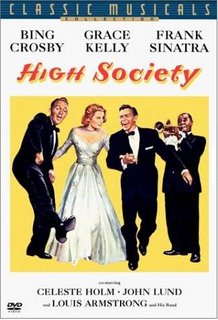
high society


I recently viewed the classic film High Society, and couldn't help but note that at certain points, Grace Kelly's voice sounds exactly like Audrey Hepburn. In fact, my wife who was in a different room and overheard the movie, thought I was watching a Hepburn flick.

Is this merely a coincidence? Does it perhaps indicate that Hollywood bosses were either knowingly, or subconsciously drawn to certain qualities in these screen sirens voices? Could it simply be a common 1950's styled falsetto acting method, which actresses would make use of?

Inquiring minds wish to know more.

On a totally unrelated note, a story in todays NY Times relates of an individual who claims to have collected nearly 2,000 dope bags. One thing that quickly caught my eye was this quote:
"The bags, which are generally made of plastic or wax paper, bear names or images that identify the contraband inside. Those labels — part turf marker, part marketing message — allowed users to differentiate among dealers and evaluate the drug’s purity."


Screw the FDA -- who needs them? Even the drug dealers understand how important the elements of name-brand recognition and a consumers' goodwill are in the free market in respect to the fact that there are no government guarantees to product quality and safety when you are talking about illicit substances.

This is not to say that drugs are a totally unregulated market; only that in one aspect, in which the FDA pretends to provide safety and quality assurances to Joe Consumer when he buys a bag of Dorito's, the illusion of an FDA guaranteed product obviously does not extend to black market products, and yet there is a huge market for these products in which your only guarantee to a decent product is the goodwill and repeat business the dealer hopes to win from the user.

And it's sad to note that I would choose the voluntary honesty of the drug dealer over your everyday agency of statistical murder, joints down.

Thursday, July 27, 2006

the ADA is addled


I love to read Greg Perry's articles, and still would even if he weren't born handicapped, as he lovingly calls himself. All this courtesy of a man born with three stubby fingers, one leg, a dazzling intellect and an even bigger heart.
In a brochure written for business owners, the ADA states, "It is illegal to segregate people with disabilities in one area by designating it as an accessible area to be used only by people with disabilities." By their very own words, no accessible area can be segregated solely for use by the handicapped.

Why don’t you test how little the ADA’s authors meant this; park in a handicapped parking space some time without a permit.

So no area can be designated as a handicapped area because doing so would segregate (and separate) the disabled. Yet virtually every aspect of the Americans with Disabilities Act does just that. The ADA’s entire massive collection of rules and regulations states how areas must be changed, marked, and separated for those with disabilities. The very specifications of the ADA violate its own statement against segregation. Nobody cares.

Thursday, July 20, 2006

the other drug war

Sometimes I go through my old posts to see what finer points I might have overlooked at the time, glossed over due to an insufficiency of knowledge, or got completely wrong.

Although my intellectual background was once staunchly politically conservative in nature, and necessarily consequentialist, I think (and hope!) that I've shed that psychological baggage to the point that while recently reading Hoppe's Democracy: The God That Failed, I was made painfully aware of how far I've come as I cringed over his critique of societal structure being unnaturally corrupted via the welfare/warfare state. I've also become more sympathetic to the the left-libertarian movement, so I don't have a dogmatic aversion to some leftist-aligned agendas such as feminism, abortion or being anti-war. Of course my position as such has my folks scratching their heads wondering if I'm a conservative or a liberal, but overall I think they're slowly learning!

What sort of stumped me before, and seems embarrassingly simple now, was the question, or have you, the free rider "problem". The "problem/question" includes a presumption that I no longer assume; that maximum societal efficiency can be derived through instances of coercion. I now understand that only through free, uncoerced, and voluntary exchange can individuals (and ultimately society) maximize their wealth.

Just to go back to the question though, there was also a presumption that the lack of monopoly privilege for all sorts of intellectual property would stem the well of creativity, as presumingly there would be no way to reward and incentivize the creator into sharing his knowledge. Supposedly without this incentive, we wouldn't have new medicines as nobody would want to invest in the R&D, conduct long clinical trials, just to have some competitor copy their formulation and manufacture a low-priced knock-off.

And so a while ago, Kevin Carson and His Merry Men brought up many good points that lay the blame for high R&D costs at the governments' door. Aside from that, Kevin argued that the patent system in place distorts pharmaceutical research into compounds which are more readily patentable, and not those which are most innovative and useful to the consumer, a direct attack against the idea that monopoly incentives are beneficial to Joe Sixpack Individual.

As Stephan Kinsella, an ardent defender of private property rights, and the warrior leader of the anti-IP intellectual battle evisceratingly writes on the Mises blog:
Hey, I know--let's trust the same government who set up the FDA costs and roadblocks to set up a patent office, and give you partial ownership of others' property to incentivize you just enough to overcome the costs they imposed on you with the FDA and taxes and regulations. Beautiful! And if that's not "enough" incentive, establish a government panel of "experts" to give you "enough" of a reward paid by taxpayers. Beautiful! I like it!

Wednesday, July 12, 2006

broken windows raises wealth


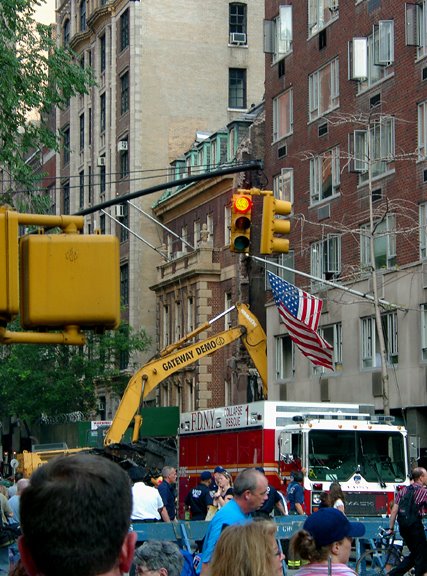
In what I think is the first time I've philosophically agreed with something written in the NY Post, the paper speculates that the explosion that destroyed a Midtown Manhattan townhouse actually increased the value of the property!

Although we all know that broken windows do not generally lead to prosperity, in this case, where a property was artificially constrained under the unduly burden of landmark and zoning regulations, the market value of the property was effectively inhibited and lowered, hence lowering aggregate societal wealth.*

As I have wrote several times in the past, the equivocation of rising property prices to an increase in real wealth is nonsense. Falsely believing in such leads many people to consider the effect of landmarking to be beneficial (and on net to outweigh the costs of such market intervention), since empirical evidence seems to correlate the event of landmarking to an increase in property values within the neighborhood.

Of course once you realize that landmarks does not increase wealth, and essentially is an artificial reduction in housing supply, we can expect property prices to shift somewhat upwards in relation of a higher ratio of bidding to a decreased housing market.

Now although in this instance real capital goods were destroyed, this was presumingly an act of "creative destruction", because the owner bypassed the medusa of imposing bureaucrats who wish to freeze New York City into a fairied vision of its past. In doing such, the owner opened up an opportunity for a developer to construct a building more in tune with the market demand for its available floorspace, bringing along greater societal wealth in the process.

Sadly enough, the granfalutin' head of the odious landmarking commission, Robert B. Tierney, in his vain glory visited the site of the explosion yesterday to survey the damage, and to proclaim to all New Yorkers, that fear not, he will make sure that whomever comes along to construct a new edifice will have to survive the gauntlet of the landmarks commission when seeking approval for the new construction, an open invitation I'm sure many will want to pass up.


*This is not to say that in the truly free market the condition favorable to an even higher density construction would be likely, because current housing supply is shaped mostly in part by arbitrary zoning ordinances, varying neighborhood densities to a degree which would be unlikely to arise under laissez faire. At the same time, in the real world, demand on this particular parcel is sharpened because of constraints elsewhere, helping to cartelize the housing supply to the strata of society who want to keep it to themselves.

Friday, June 23, 2006

down with schooling

But hey, I'm totally for education. When I explain this others, I can see the look of consternation looming over their faces, as they seemingly think, "what the hell is he smoking now?"

Well for once, I can at least point to this wonderful article by John Taylor Grotto who writes:
Mass schooling of a compulsory nature really got its teeth into the United States between 1905 and 1915, though it was conceived of much earlier and pushed for throughout most of the nineteenth century. The reason given for this enormous upheaval of family life and cultural traditions was, roughly speaking, threefold:
1) To make good people.
2) To make good citizens.
3) To make each person his or her personal best.

Alexander Inglis's 1918 book, Principles of Secondary Education, ... breaks down the purpose - the actual purpose - of modern schooling into six basic functions, any one of which is enough to curl the hair of those innocent enough to believe the three traditional goals listed earlier:

1) The adjustive or adaptive function. Schools are to establish fixed habits of reaction to authority. This, of course, precludes critical judgment completely. It also pretty much destroys the idea that useful or interesting material should be taught, because you can't test for reflexive obedience until you know whether you can make kids learn, and do, foolish and boring things.

2) The integrating function. This might well be called "the conformity function," because its intention is to make children as alike as possible. People who conform are predictable, and this is of great use to those who wish to harness and manipulate a large labor force.

3) The diagnostic and directive function. School is meant to determine each student's proper social role. This is done by logging evidence mathematically and anecdotally on cumulative records. As in "your permanent record." Yes, you do have one.

4) The differentiating function. Once their social role has been "diagnosed," children are to be sorted by role and trained only so far as their destination in the social machine merits - and not one step further. So much for making kids their personal best.

5) The selective function. This refers not to human choice at all but to Darwin's theory of natural selection as applied to what he called "the favored races." In short, the idea is to help things along by consciously attempting to improve the breeding stock. Schools are meant to tag the unfit - with poor grades, remedial placement, and other punishments - clearly enough that their peers will accept them as inferior and effectively bar them from the reproductive sweepstakes. That's what all those little humiliations from first grade onward were intended to do: wash the dirt down the drain.

6) The propaedeutic function. The societal system implied by these rules will require an elite group of caretakers. To that end, a small fraction of the kids will quietly be taught how to manage this continuing project, how to watch over and control a population deliberately dumbed down and declawed in order that government might proceed unchallenged and corporations might never want for obedient labor.

That, unfortunately, is the purpose of mandatory public education in this country. And lest you take Inglis for an isolated crank with a rather too cynical take on the educational enterprise, you should know that he was hardly alone in championing these ideas... Men like George Peabody, who funded the cause of mandatory schooling throughout the South, surely understood that the Prussian system was useful in creating not only a harmless electorate and a servile labor force but also a virtual herd of mindless consumers. In time a great number of industrial titans came to recognize the enormous profits to be had by cultivating and tending just such a herd via public education, among them Andrew Carnegie and John D. Rockefeller.

Wednesday, June 21, 2006

pouring lemon juice on a paper cut


As you probably can guess from the subtitle above, discussions of real estate usually interest me.

And sometimes they irritate me. Ok, most times, but that is because I can get pedantic when it comes to the most-misunderstood business that everyone in the world has to deal with at some point in their life.

So then please allow me to quote from Brownstoner.com, a popular local real estate blog, in an article titled "Saving the Short-Sighted From Themselves" in regards to the recent landmarking "victory" in Riverdale, NYC.

We knew a hotly-contested decision on landmarking the 250-odd houses that make up the Bronx enclave of Fieldston was imminent, so it was with some relief that we read this past weekend that cooler heads had prevailed and that the City Council had in fact ratified the designation back on April 26... As for the dopes who fought the landmarking, they'll be thanking their neighbors as their property values rise; and if they really miss being able to build some oversized monstrosity, they can cash in and move.
As usual, he has the positions reversed. The folks threatening their neighbors with glorious state-sponsored violence and robbery are the so-called "cooler heads" whom have prevailed, whilst the victims of land-robbery are dopes for trying to preserve their wealth.

But of course, the elitists know what's best for New York, even when they are totally wrong.

Because the Brownstoner blog is not the right setting for a critical discussion of simple economic topics, I was going to write something here on my blog about it, as I have in the past.

The first mistake of course is the implicit assumption that rising asset prices are beneficial towards the aggregate wealth of society. It's not, and counterfactually, it signifies that aggregate societal wealth has actually decreased.

Also, the question of cui bono? goes unexplored.

Who exactly gains from a reduction of available land resources? Certainly you might expect that many land owners will be in favor of landmarking, because a reduction in supply, without a commensurate change in demand (for an inelastic good), will lead to higher prices as the scarce factors are bid higher and higher.

But while the sellers are happier to receive higher prices, the buyers as a whole have lost by that very same amount! (Thank you Bastiat and Hayek.) In short, by their same scalar measurements of interpersonal utility, the sellers have seemingly gained at the expense of the buyers.

But that is not all. The many others that are the 'losers' of this policy are the countless individuals who cannot afford the higher prices and simply seek housing in a different market. In short, such wondrous policies drive the low and middle class from the neighborhood, which you would think make the egalitarian central-planners think twice. But no, they are busy tsk-tsking the "dopes" who opposed the landmarking policy, which is supposedly in their favor as the current owners.

The second mistake is confuse prices, with value. To quote LewRockwell.com author Paul Tolnai:
Let's look at the housing stock of a country. Within the last few years, many homes have sold for twice the price of what they fetched, say, 5 years ago. OK, so does that mean we can extrapolate these marginal prices to infer that the value of our housing stock has doubled, and hence we as a nation are wealthier? Looking only at the housing stock that existed 5 years ago, has its utility increased? How does wealth relate to prices?

According to the Fed, these price increases are evidence of the robustness and health of the American economy. We are now supposedly wealthier. But isn'’t this like referring to increasing "No Child Left Behind" test scores to answer the question of the day: "Is our children learning?" A given house has a fixed utility. Its utility does not go up simply by having occupied it for the last 5 years. If its price has gone up dramatically, is one dramatically wealthier?

Wealth it seems to me is related to the production of goods (and services) that people want to have (essentially manufacturing) and is not determined by prices, although price movements may be indicative of changes in wealth. If that were so, what would the relationship be? If increasing the supply of goods that people want to buy, whether through importation or domestic production, means more wealth, where would price fit into this picture of wealth measurement? Let's go back to housing.

To some degree, increasing the manufacture of houses would increase wealth, but this would, ceteris paribus, have a depressing effect on house prices. So I reason that falling prices is a good measure of wealth creation (such as the prices of electronics and computer hardware). In the 19th century, there was a slow decrease in the price level over the entire century (excepting the Civil War era - think of Lincoln's greenbacks, which were later declared unconstitutional). It would seem to make sense that with a steady amount of money, individual ingenuity (human action) is going to tweak the production process every year to make it more efficient (less resources for a given output) to produce a given good, which will tend to lower the price. The price reduction for this good will free up capital to produce other, or better goods - all within a framework of falling prices.

Notice I haven't addressed the merits of landmarking, because I don't think there are any to be discussed. I personally feel that piles of stone and dirt, however beautifully arranged, do not undergo a transcendence of any sort, and I wouldn't threaten violence over an owner's personal decision whether to preserve or to destroy them.

I also assume that the owner will do whatever is his best interests to increase his wealth, whether that means voluntarily preserving the structure, or demolishing it. And yet the only way to increase the aggregate of societal wealth, is on that very personal basis.

So in short, its the myopia on the part of the economic-illiterate policy wonks, that destroy societal wealth, escalates and reifies class conflict, and than has the gall to pour lemon juice onto the papercut they dealt you, with their caustic slaver.

Thursday, June 08, 2006

back, with extra gadgety goodness

I just got back from a wonderful two week vacation to Israel, with quite a number of insights I have never appreciated before. I am not quite ready to explain myself, but I hope to some other time.

In the meanwhile I thought it worth sharing my wonderful experience with a digital picture frame from Philips. After scouring through tens of Amazon customer reviews, dozens of manufacturer and reseller websites, numerous e-text specification manuals, I have come to the conclusion that the Philips 7-inch Digital Picture Frame w/Clear Frame was my best solution.

In all regards that I considered important; clarity (higher screen resolution), great color reproduction, screen size, capabilities, and product aesthetic, I believe that ex ante post these considerations have been well met by this product. Although this particular model was a bit pricier than its competitors, the tradeoff in those aforementioned qualities was worth more to me than the difference in price.

The best part about all this was yet to come. After my wife and I arrived home from the airport, I picked up the digital frame from my parents where it was shipped to, slapped in a memory stick fresh with vacation pictures, and set it up in our kitchen, playing back a montage of these very recent memories, much to my wife's very suprised delight.

Tuesday, May 23, 2006

i'm outta here...

I will going away for the next two weeks. While I will be lugging around my newly-purchased MacBook, I doubt I will have the opportunity to write out any 'profound' material related to this blogs' interests, although I might be tempted to post some snapshots and general travel commentary; but don't count on it.

I know my output volume has been dropping to historic lows, but this is simply the result of an increased output into other activities: reading, movies, studying, and of course, towards the disutility of labor (one must find a way to pay for his expensive computer toys, no?)

Peace and Anarchy Out!

-iceberg