Friday, March 24, 2006

Joseph Sobran on Democracy

Quote of the day year:
"So when the wolf pounces on your lamb, just ignore the pitiful bleating and remind yourself that this is a democracy, where every sheep can freely express its preference for which kind of wolf it wants to be eaten by. Many sheep, perhaps understandably, prefer a wolf in sheep'’s clothing, which is after all the basic idea of democracy. So far it has worked pretty well. The wolves all agree on that, and they want to spread democracy everywhere."
Is there anyone else out there who agrees with my assertion that democracy is the dumberest thing since general macroeconomic theory?

Thursday, March 23, 2006

Suckers, Patsys, and Friars

Here is a real howler. Via The Real Deal, comes this article in the New York Observer's real estate section.

The article states:
The Landmarks Preservation Commission's Web site recently posted a study by the Independent Budget Office that analyzed residential property values in the city's various historic districts. The report is not new--it's dated 2003--but its conclusions seem to back up preservationists' claims that historic districts increase property values.
Oh they do, don't they?

On face value, this is supposed to be a positive phenomenon, showing that wowwee, government planning actually works!

The question remains, do rising values necessarily imply a positive outlook on the housing market?* Has that truly been beneficial to everyone? Could it be possible that it's beneficial only to a select few, those who already are comfortable in their purchased homes?

Alas, that question is never answered, but worse so, it is never even asked.

Coincidentally, just last week, I fired off an email to a dear Austriomentor™, asking him:
If a home or business is designated a landmark, the owner suffers a reduction in property value, both for their personal use and when the owner attempts to sell, it will fetch lower prices since there isn't much use the next owner can expect to get out of it. At the same time though, since there is an intervention causing artificial scarcity of land uses, it will drive up the price of housing/business for everybody in the market.
In hindsight it's not such an intellectual obstacle to overcome in this perhaps seemingly counterintuitive example, and shortly after I sent the email, I was kicking myself in the pants for not being thoroughly convinced of its truth sooner.

While I'm tempted now to reword that question, I think the point comes through clearly.

Anyway, I fired off a quick rebuttal on the NYO's blog, mocking them for being the Landmark Commissions patsy:
Well duh! If government intervenes in the market and restricts supply, ceteris paribus, prices will rise! (zoning, landmarking, and other land usage restrictions place artificial and arbitrary constraints on supply)

It doesn't require any empirical research to prove this a priori fact.

Secondly, and less well understood is the fact that the affected property owners suffer unquantifiable losses when restrictions are placed on their property. For example, they might have wanted to add a penthouse on their roof, or changed what they think is an ugly facade. This is even before you tack on the costs of compliance with the property owners having to go through yet another layer of bureaucracy to make alterations to property they own in a nominally 'free' country.

*I'm now thinking that this whole confusion only begins because some people can't distinguish between prices and values. Costs, for that matter too.

**Friar is Israeli slang for biatch when used in the sense of "sucker"

Tuesday, March 21, 2006

fooling themselves

Earlier today, I was having a conversation with my mom, in which when she tells me that she is babysitting my niece, since my sister had to run a few errands. Presently, she mentions that she doesn't even have to watch her since my niece's therapist is working with her.

"What?!" I interject, "Why is a perfectly normal toddler receiving therapy? I don't know for certain, but I don't ever remember a time with so many children receiving therapy."

My mother presently concedes that in the last few years, therapy for various issues is being administered to more and more children. Even my wife's only two nephews, one who is age 4, the other one age 2, are also undergoing "occupational" therapy and speech therapy, respectively.

Maybe this is only some anecdotal phenomena, local to only my circles of influence, but nagging voices of economists long deceased tell me that this is probably the result of government setting the price to zero, a price floor needlessly causing overconsumption.

In any case, I admit that I can neither criticize from knowledge nor experience in the field of early childhood development therapy, but only that lately it seems that most young parents I know are utilizing the "free" services of a speech therapist because their 1-2 year old child isn't an effusive chatterbox socialite, and besides, the "government is paying for it anyway".

Which we know isn't true. Government has no wealth to speak of, only that which is has already confiscated from private holders or will do so in the future. But people tend to ignore costs and they irrationally adorn blinders to perpetuate a disconnect between low/no-cost services and goods provided, and the respective invoice.

What I'm afraid of is that therapists have made themselves comfortable that government insures them a steady flow of public-paid business. They will not have any objectivity in the matter when it comes to deciding whether a child requires therapy. I, for one would not trust the judgement of a therapist in such a case. If the price of the services rendered were paid for by the parties responsible, therapists would risk ruining their reputation by taking on clients who didn't need therapy, as the paying parents would find out upon doing their homework of getting a second opinion.

(The ideal in this case would obviously be to make each user responsible to pay for the services rendered in the private market. But in this case, the government has declared it free, and essentially is taxing the wealth of society to pay this boon to the industry. What can make this possibly worse is for the government not to pay it from current revenues, but to finance it with a bond, which only further abstracts the costs to taxpayers; which after all, taxpayers at some later date will have to pay back that bond with interest.)

One is only deluding himself to think that there are any goods which are free, and furthermore it's impossible to make a rational decision in such a case regarding the question of therapy, when the only indicator one could go by is the price system, which has now been tampered by government intervention on the side of costs.

"What could possibly be the harm?" you ask, "so there are children recieving unneccesary therapy, what could be so bad about that?" Well for one, you aren't acting in the child's best interest when you saddle him later with the costs of your foolishness. Secondly, you are at best only diverting resources, at worst you are taking present wealth and destroying it. I know people who won't dare waste a morsel of food, but in this case are content to delude themselves.

Vernon Smith (via this Cafe Hayek article) writes in the WSJ regarding healthcare and third party systems:
Here is a bare-bones way to think about this situation: A is the customer, B is the service provider. B informs A what A should buy from B, and a third entity, C, pays for it from a common pool of funds. Stated this way, the problem has no known economic solution because there is no equilibrium. There is no automatic balance between willingness to pay by the consumer and willingness to accept by the producer that constrains and limits the choices of each....

....if third-party deep pockets pay whatever is the price B charges A this year, the effect is to reinforce the incentive to raise the price next year. Spending escalates, which leads to a demand for cost control. In health care there is increasing control over access to medical services. Insurance companies disallow patient free choice of physicians, clinics and hospitals outside their approved network. Physicians and medical organizations face escalating administrative costs of complying with ever more detailed regulations. The system is overwhelmed by the administrative cost of attempting to control the cost of medical service delivery....

If there is a solution to this problem, it will take the form of changing the incentive structure: empowering the consumer by channeling third-party payment allowances through the patients or students who are choosing and consuming the service. Each pays the difference between the price of the service and the insurance or subsidy allowance. Since he who pays the physician or college calls the tune, we have a better chance of disciplining cost and tailoring services to the customer's willingness to pay.

Many will say that neither the patients nor the students are competent to make choices. If that is true today, it is mostly due to the fact that they cannot choose and have no reason to become competent! Service providers are oriented to whoever pays: physicians to the insurance companies and the government; universities to their legislatures. Both should pay more heed to their customers -- which they will if that is where they collect their fees.

I have always thought it was obvious, that third-party healthcare would become a nightmare for doctors and their patients. Doctors who bill insurance for treatment will pad up the bill, trying to see how much will 'stick' with the insurer. The insurance companies play the opposite game, trying to limit how much they are willing to pay for the services, and what services they will even cover.

Of course, every one knows that the price being quoted to the insurance company is significantly higher than what a patient would regularly be charged. But doctors, who are better suited to treating bodily ills must now become bold entreprenuers who have no idea of how much they can expect to be paid from the insurers.

How can a doctor rationally set a price, where there is barely any direct input from the consumer of these goods? Is it really that suprising that more and more doctors are dropping out of medicare participation and other third party systems?

Don't even think of talking me into a "national healthcare" system.

Wednesday, March 08, 2006

the real think tank

What is it about water that makes the human brain revv?

I'm pretty certain that I'm not unique to find that I do some of my best thinking in the shower. (Is it due to a psychological release of the conscious, allowing the murkiest of subconscious thought to float to the surface? I don't know, but I would love to hear from a more qualified individual on the matter.)

This being the case, I often find myself dictating grandiloquent ideas to be jot down by no one in particular while making use of my home's showering facilities.

It appears that there are inventors who have capitalized on this market. I have seen easels meant to be hung in one's shower as to capture the rapture of water-born ideas. I remember long ago watching a science program, I think it was called Discovery 2000, in which they demonstrated a waterproof notepad and writing implement invented by an eccentric Japanese scientist who often had eureka(!) moments while swimming in his lap pool.


Now only to come up with a reasonable explanation for my wife who will shortly be exasperated to learn that I shower with the some very feminine muses.

Friday, March 03, 2006

meme of fours

Zorks!

I've been tagged by Reformed Socialist-Kibbutznik, now-turned Mises Fellow, Anarchist-Extroadinaire B.K. Marcus the First of Charlottesville, VA by way of Morningside Height's God Box.

And now, without any further ado, I give you the 'Meme of Fours'.

Four jobs I've had:

  1. Junior Highschool summertime employment as a corporate MIS/IT worker
  2. Detergent & household cleaning products salesman
  3. Property Manager and Investor Relations for a real estate firm
  4. Commercial real estate broker/analyst

Four movies I can watch over and over:

  1. Indiana Jones Trilogy
  2. Back to the Future Trilogy
  3. Star Wars Trilogy
  4. Roman Holiday (yeah, I'm infatuated with Audrey Hepburn's timeless charm)

Four places I've lived:

  1. Houston, TX (for half a year when I was 2 years old)
  2. Long Beach, NY (2 years highschool dorming)
  3. Baltimore, MD (1 year post-highschool seminary)
  4. Jerusalem, Israel (1 year of post-highschool seminary
Four TV shows I love:
  1. Seinfeld (I own the DVDs)
  2. Lost (presently downloading the TV rips)
  3. Firefly (I own the DVDs)
  4. None, since I don't own a television set.

Four highly regarded and recommended TV shows I haven't seen at all:

  1. 24
  2. Grey's Anatomy
  3. Sex in the City
  4. Sopranos
Four places I've vacationed:
  1. Panama City, Panama
  2. Southern California (L.A., San Diego)
  3. Israel
  4. Las Vegas

Four of my favorite dishes:

  1. 'La Suprise' cut of steak
  2. Chicken Marsala
  3. Pounded & Breaded Veal Chop
  4. Eggplant Parmigiana
Four sites I visit daily:
  1. Mises.org
  2. Curbed.com
  3. Engadget.com
  4. Gizmodo.com

Four places I'd rather be right now: (Ok, I took a little liberty on this one)

  1. Kicking back on an aged leather recliner in a plush old library with a good book
  2. Snowboarding in Aspen
  3. A product development manager at Apple or Google's R&D department
  4. Relaxing in Central Park (NYC), sipping a cappuccino while listening to nature

Four new bloggers I'm tagging:

  1. Vache Folle
  2. Jon 'Brownstoner'
  3. Brandon Berg
  4. S.M. Oliva

Wednesday, March 01, 2006

a counterfeit bill of goods

(...or do I repeat myself?)
A principled anarchist is one that need not ever make the case that he objects to the necessity of common law, civilized order, 'public' goods or what not.

However a principled anarchist is one who rejects the unholy notion of an objective utilitarian or consequentialist doctrine, as he garbs himself in the robe of deontological ethics -- the consideration that all actions are to be judged on their own moral basis, and are not subject to a 'package deal', where one is permitted to perform actions which if performed on their own would be immoral, but when together they bring to fruition an overall, positive consequence, they are not considered immoral.

A principled anarchist who has some background in a Bastiatic† sense of economics will surely even deny the possibility of there ever being a positive, or even net gain of "good" to speak of when following the utilitarian doctrine, which for its part can never factor in the psychic and opportunity costs of disutility on the part of those who suffer a "well-intentioned" meddler's immoral actions.

Furthermore, an analysis of the goods that political anarchy (read: any government) makes pretense to deliver, whether it's industry regulation, industry standards, roads, common law, retributive and punitive justice, or a monetary and banking system, etc. are all faux goods in the sense that one could do better to obtain, instead of unwillingly exchanging life, liberty and property in pursuit of these couterfeit goods.
For example, in regard to industry regulation I have wrote in the past that:
The most valuable asset to an individual or business is their integrity, or good will. This seemingly trifle point is a big deal when the market is unhampered by regulations. As a motivating agent, it is by far the greatest incentive for people and businesses to provide the highest level of service and product. Regulations and punitive damages when instituted by third-parties, are too poor a substitute for the purpose of keeping businesses honest.
In other words, true regulation of industry can only come from within the individual firms themselves. The "regulation" we speak of in the governmental sense is but a faux substitute for this ideal of regulation.

A commenter on Catallarchy really drives this distinction of the regulation term home:
One of the confusions that all of this causes is often from terms.

As someone who has worked with “electricity", I can tell you that you must always regulate energy. What’s that you say, you are for regulation?

Well, not rules in the way you mean. Unregulated electricity would cause most of the electronics in your house to malfunction. (power surge), so, to a physics major, when you say deregulation, they think you are talking about lightning strikes.

secondly, most folks of an inteligent nature realize that when most folks are speaking of “derugulation” what they really mean is regulation that is more favorable to their own personal interests, not a lack of regulation.

Now, “real” derugulation is nothing of the sort. It’s getting out of the way of the self-regulation free market. Not an absence of regulations, but letting the market set them.

Looking back at Cali dereg, it was nothing of the sort. To this day, I don’t know what that was.

But, I have this (following) example to show me what deregulations actually means to many in this country(but it relates to content transmission rather than pure energy).

Years ago I lived in one of the first towns to have cable TV in IL. Because the market was unregulated, becuase the cable company required right of way on our land (we were a “self-rule” corporation, yes a village, but a self-rule incorporated village), we were able to get an excellnt deal with the company. I had a chance to meet one of the VPs from that company at the time, and I knew from him, they were very happy with the deal. They made profits, we allowed them the rights of way and other assistances that in cases where no deal had been agreed to, possibly been costly from a management perspective.

That is all gone now. Why? Well, you see we were deregulated. Now, we had to except national enforced mandates, rather than negotiate with the company directly. Should there be problems with the service, tough luck charlie. Previously, the free market was still open, and since we had helped build the infrastructure, we could make deal with a different company that would better service our market preferences.

I would much rather go back to that “regulated” state, that had no regulations other than the fact that two incorporated groups of people had agreed on.

So, in that case: Regulated meant contracts between individuals, negotiated without fed interference, while Unregulated meant that the feds would preempt our negotiations.

In regards to standards, I recently posted to the Mises blog this little rejoinder to a glib fellow calling himself "anti-lib" who argued that without government, we would have no system of enforceable standards, from which I take it that he believes it undesirable for people to make their own choices:

What I think also warrants a mention is that the only true standards are those which are voluntarily agreed upon by the market participants. Anything enacted through force or coercion is tainted with the possibility of being the less than optimal solution.

There are plenty of standards which didn't require the state to intervene. Graphic, motion and audio codecs have standardized baselines which are operable cross industry. For example Sony's DVD discs work on Toshiba set top players.

The lesson you draw from that is that manufacturers will often find it in their interest to market materials to their customers in standardized formats. While its not a rule, it seems the only time "standards" have been ignored is when consumers deem the misnomered 'standard' to be inferior to a non-standard alternative (witness the success of iTunes despite its proprietary lock to the Apple iPod). When success is not the case, the usual culprit will most likely be the results of a government-created monopoly which favors the current proprietary solution.

In any case, there never is an instance when standards should need to be imposed; for if the standard is truly the optimal, it probably will be whole-heartedly supported by market participants. If the standard is less than optimal, you will see the opposite. If coercion is needed to impose the standard, its probably less than optimal, and in all cases exudes elistism on part of the enforcer.

But what about roads?! No problem.

Common Law? Dispute Resolution? Collective Services? Pollution? Big deal! (Thank you Stefan Molyneux)

Justice? Hah!
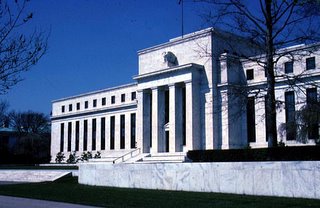
Money and Banking?

I don't think I even have to explain how governments, and in the U.S.'s case, through its Federal Reserve and its cartelized banking system have taken monetary counterfeiting to a entirely new nadir of despotism and fraud.

You will also find that the principled anarchist is one who does not have the conceit to pretentiously guarantee the delivery of these goods in absense of the government. But he is ready to say that whatever is to society's optimal benefit will spontaneously arise in the absense of the state's coercive matrix, and that these goods, unlike the government's faux substitutes are the real deal.

Choose wisely.

† Bastiatic, after Frederic Bastiat, whose words remind us to encompass all the costs of any transaction, not just the visible ones we see before us. This would be in principle the antithesis of a Coasean, Pigouvian, or Kaldor-Hickian analysis which impossibly, yet falsely lumps subjective valuation of costs, into objective societal costs which could be studied to measure for efficiency.

Monday, February 27, 2006

the opportunity cost of political anarchy

While it's entirely impossible to quantify and calculate the total cost that government tacks upon society's individuals, Michael S. Rozeff's daily article on LewRockwell.com attempts to give us a very rough, but low-ball estimate of just the monetary costs:

$48 Trillion!

According to Rozeff, that's approximately three times the wealth contained within the stock market that government drains from society. Before one criticizes these numbers, bear in mind that Rozeff acknowledges the impossibility of knowing the cost of those dollars to the individuals they were parted from, and does not attempt to include all the incalculable psychic damage (unhappiness, stress, etc.) due to the existence of the government and its pseudo-regulations.

Tuesday, February 21, 2006

living la vida anarquia

Over a month ago, I wrote a little about seeing our everyday, seemingly statist-ified world in the more pleasing light of anarchy. To briefly quote:
Starting from there, I came to see present human existence in a, ahem, state of anarchy. Yes, even with nation states and governments, I still maintain that we have workable anarchy today. This is because anarchy is but the label of the grid I use to perceive the order of reality.

When I look through this grid, I see criminal gangs calling themselves governments, who are merely cruel parasites to the human race.
I was then overjoyed to see this Mises post discussing an article published in the Summer 1979 issue of the Journal of Libertarian Studies which promises that it "blows apart the way you've seen the world."

The topic of course is "Do We Ever Really Get Out of Anarchy?", and it goes on to make the case that the idea of government, by its definition does not truly exist, and that our coexistence is but a specific shade of political anarchy.

It's really good stuff, have a look.

Saturday, February 18, 2006

milestoned!


I'm proud to report here, that I have just finished this fine work, hopefully just one among many I will find it in my favor to study.

If there is an initiation or hazing ritual that I must submit to finally join the proud line of the Austrian 'cultists', would someone please show me where to sign?

Friday, February 17, 2006

mirror, mirror on the blog

"Everytime I read one of Iceberg's comments I imagine him in a dark room with the shades drawn sitting among notebook after notebook after notebook after notebook filled with handwritten scribblings...all stacked to the ceiling."

Wow, I'm touched.

Tuesday, February 14, 2006

one bad policy deserves another


The interventionist solution to the eyesore of shortage queues created by the socialist medicine monster: Ban the line forming!

Saturday, February 11, 2006

Do Blondes Prefer Gentlemen?

One of the upsides downsides of studying economics is how it effects your everyday, mundane cogitation. I now find it difficult to refrain from trying to analyze the praxeological underpinnings of even the most bizaare, non-economic related subjects.

Okay, maybe it's not the worst thing that has happened to me!

To illustrate the perfect case, just the other day I was mindlessly staring at a blond haired woman as she strolled by. Immediately what came to mind was a question of why many women like to dye their hair.

Now of course, the action axiom tells us that people act in the intentional expectation that their actions will help them to achieve greater satisfaction.

Okay, how will dyeing one's hair bring about greater satisfaction? I can think of two ways. First, because the individual believes that they look better with this other hair color, and secondly, because the individual is wanting to grab the attention of another with what the individual believes makes them more desirable to the other persons satisfaction.

But then I realized that the second reason must go deeper than that. After all, the woman who dyes her hair to satisfy the desires of men is ultimately doing it for the benefit of herself; that in the hope that some man will notice her and desire her companionship.

Wouldn't this scenario then fall under the dictum of "demand dictating supply"?

Anyway, as I was googling around I found what I thought is an amusing article written by an econometrician trying to gauge the supply and demand schedules of the personal ad marketplace.

Monday, February 06, 2006

the mythological caduceus

Over at the Mises Institute, Robert Murphy explains what libertarians and free market economists mean when they speak of 'the market'.

Laissez-faire economists are often accused of "worshipping" market (or what can be called "equilibrium" in the present context, though the two are different) prices. But this is rather misleading. If I oppose murder, it's not because I worship other people's lives. Or, if I don't let my ten-year-old neighbor tinker with my car engine, it's not because I worship its current state. The former case is simply an implication of my views of justice, and the latter case follows from my knowledge that the car works fine right now, and my neighbor's tinkering will only mess it up.

Both aspects lie behind the (natural rights) libertarian's defense of freely floating market prices. On the one hand, if one believes in property rights, then it automatically follows that price controls are immoral. After all, a price control involves the government using its guns to prevent owners from swapping their property at a mutually agreeable price.

But beyond the issue of property rights, there is also the pragmatic aspect. Simply put, if the government sets the legal price below the market level, there will be a shortage; customers will want to buy more units of the good than suppliers will want to sell. There's no way around this: The equilibrium price is that which equates the quantity supplied with the quantity demanded. Left to its own devices, there is every reason to expect a market will tend toward the equilibrium price, although of course it will always be disrupted by changes in the data (supplies, tastes, etc.).

Thus said, people to whom the phrase "free market" means something more than a political catch-phrase, are not worshippers at the temples of Hermes/Mercury nor the secular equivalent. They generally do not subscribe to inexplicable deus ex machina views on market operation, that somehow, someway an incorporeal entity will direct us mere humans to a higher, more satisfying plane of existence.

They may be in fact, scientists of the behavoral science of praxeology, to whom the study and understanding of the human behavior of action is paramount. If they must be said to worship something, it could only be their belief in the general goodness and cooperative nature of the human spirit.

As I've said elsewhere, those who are opposed to the free market are those who hold a dismal view of all of humanity, atrributing malicious and obnoxious behavior as the essense of the man's nature. Ironically, even if such nastiness was the case, the 'free market', which respects the autonomy of individuals would still be the optimal solution for humans of brutish callings. Unfortunately, this dog-eats-dog perception of humanity becomes their paranoid reality, something which I wouldn't wish upon an enemy (which somehow might rationalize his decision to damage my persons.)

As others have pointed out, if the justification for government is based upon the principle that people are naturally evil and dishonest, how could a political system run by individuals comprising of those same values elevate humanity to a better state? One merely needs to study history to see that the one common accomplishment of government has been to institute systematic coercion upon innocents, making their lives worse off in comparison to had the state never existed.

Wednesday, February 01, 2006

this time we really, really mean it


Here is something I thought was a hoot.

The NY Times article is titled "A Retailing Czar, Looking Out for Mom and Pop" and discusses a newly-created and filled bureaucratic position called "executive director of retail development" whose job is ostensibly to help spur retail development around the city.

Anyway, here is the money quote, familiar to those who know anything about the typical government efficiency of utilizing looted capital.
"We've been dividing up the community development corporation money, doling it out a little here and a little there, and it just wasn't helping anyone," said Robert W. Walsh, commissioner of the department. "What's been produced with that money is a lot of calendars, bad directories and tchotchkes. So we hired a specialist to oversee this."

A nagging voice tells me that all NY City will ever get out of this will be yet even more calendars.

Monday, January 30, 2006

a year of blogging

January 30th!

It's hard for me to believe that it's the one year blogiversary for this never-so-humble interweb-log.

My commitment to this blog and the goals thereof remain the same as last year- to further my communication skills, most notably the persuasive and argumentive skillset, which I feel I must do most to improve.

To satisfy the crowd which insists on quantitive metrics: There have been 85 posts to date, a post roughly every four days. When you factor in my downtime to include Saturdays (roughly 52) and other holidays (being stingy I'd say 30 days a year), my post rate climbs to one every 3 days or so.